

Oleshky: Hunger as a Weapon Once Again
From October 27 to November 1, a localized ceasefire was announced in the name of a humanitarian rescue operation for the residents of the city of Oleshky in the occupied Kherson region, who have been subjected to conditions of forced starvation. The situation in Oleshky is hopefully so well known, particularly for the destruction and purposeful crimes against humanity inflicted upon its population, that it requires little explanation or context. Beyond all else, it is a blockade imposed upon the residents of a Ukrainian city situated only one river crossing away from freedom and liberty in their own country. In the name of torturing Ukrainians on both sides of that river, Russian occupation forces are once again employing a tried and tested method: turning one of the most fertile places on this earth into the site of an artificial famine.
The irony is as cruel as it is deliberate. Ukraine, a country historically known as the breadbasket of Europe, is once again witnessing its people deprived of food, security, and the necessities of life by an occupying power. The methods have changed in their technical execution and have become only more effective and demoralizing, but the underlying objective remains disturbingly familiar. Blockades, the destruction of infrastructure, the obstruction of humanitarian assistance and observers, along with the deliberate deprivation of food, are not simply the consequences of war. They are instruments of a genocidal occupation, intended to break the population into submission.
The Memory of the Holodomor
This November, Ukrainians around the globe commemorate the genocidal acts of the Holodomor, the manufactured and government-sanctioned famine imposed by the Soviet regime through forced collectivization, grain requisitions, confiscations, and the systematic destruction of Ukrainian society. Millions perished, not because Ukraine lacked food, but because Moscow took it and made the decision that Ukrainians would be denied the right to live. The systematic destruction of Ukrainian intellectual, political, and cultural life accompanied the famine. The countryside was starved while the intelligentsia was imprisoned, deported, or executed. It sought to eliminate the foundations on which an independent Ukrainian national consciousness could survive.


The Holodomor was not an unfortunate administrative failure. It was hunger as a political weapon. It used this hunger to achieve what military occupation and political repression alone could not: the submission of an entire people; yet it failed.
And this is precisely why Oleshky matters.
We cannot commemorate the Holodomor as an isolated historical tragedy while ignoring the methods through which Russia continues to wage war against Ukrainians today. Nor can we separate the memory of those who starved in 1932–1933 from the people currently being deprived of food, medicine, and freedom under Russian occupation. History does not repeat itself in identical circumstances, but the intentions and methods of imperial domination are consistent.
The Diaspora's Silence Is Not Neutral
American context and the Ukrainian diaspora's passivity are themselves part of the messaging.
In the United States, where the Ukrainian diaspora has spent generations building institutions, preserving culture, and advocating for an independent Ukraine, there is an unfortunate tendency to treat the current war as a distant, distorted repeat of history rather than an existential struggle of today. Too often, the conversation shrinks, even within our diaspora, to congressional appropriations, negotiations, political personalities, and the supposed need for compromise. Compromise. These details matter, but they cannot substitute for the fundamental question: what happens to Ukrainians if Russia is allowed to win? This is what Americans need to, and used to, understand.
The Ukrainian-American community must recognize that its silence, hesitation, and unwillingness to confront the consequences of capitulation are not politically neutral. When the discussion of peace excludes the experiences of those living under occupation, it contributes to a narrative in which their suffering becomes an acceptable price for diplomatic convenience. When we allow the conversation to focus exclusively on the cost of supporting Ukraine, without asking what the cost of abandoning Ukraine will be, we have already conceded an important part of the argument.
Capitulation is not peace. It is the transfer of responsibility for the future of millions of people into the hands of the very government that has demonstrated its willingness to destroy them.
An Occupier's Promises
Ukrainians understand the cost of capitulation and the consequences of trusting an occupying force. Whether under the Polish Second Republic and its policies of pacification, the German Reich and its exploitation of Ukrainian resources and labor, or the Soviet Union under Moscow and its forced collectivization. Every occupying power has brought one certainty: terror. The historical circumstances differ, and these regimes cannot be treated as interchangeable, but the lesson remains consistent. An occupying power does not recognize the rights of a conquered population simply because it has signed an agreement or declared a ceasefire. An occupier's promise means nothing, whether it be Poland to the League of Nations on Ukrainian autonomy, or Germany to Chamberlain on Czechoslovakia. The deceitful take goodwill as weakness.
An empire's promises are made to secure submission, not to guarantee peace or liberty.
What Ukrainians Are Fighting For
When we discuss the modern condition of Ukrainians, both within the internationally recognized borders of Ukraine and in the occupied territories, a familiar situation emerges. The rule of the day is terror, fear, and the constant threat of artificial death and suffering. This is the central reality ignored by Russian apologists on both sides of the political spectrum: Ukrainian forces are not fighting simply for territory, borders, or strategic positions on a map. They are fighting to rescue their countrymen from a system of occupation that seeks to destroy their political identity, cultural inheritance, and ability to exist as Ukrainians.
A city is not simply a collection of buildings. It is the people who inhabit it, the language spoken in its streets, the traditions practiced in its homes, and the memories passed between generations. To surrender a Ukrainian city to Russian occupation is not merely to redraw a line on a map. It is to place its population under a regime that has repeatedly demonstrated its intentions toward Ukrainian identity. The deportations, forced assimilation, political imprisonment, destruction of cultural institutions, and persecution of those who refuse Russian citizenship are not incidental features of this occupation. They are part of its machinery.
From the Executed Renaissance to Today
One hundred years ago, the last remnants of the Ukrainian People's Republic were forced into exile, while the bright minds of what would become known as the Executed Renaissance were systematically imprisoned and murdered. The Ukrainian intellectual and political classes were destroyed in the hope of finally crushing the Ukrainian dream. Writers, poets, historians, artists, educators, and political organizers were eliminated because their existence represented something Moscow could not tolerate: the possibility of a Ukrainian nation with its own independent cultural and political future.
The executions at Sandarmokh, the mass repression of Ukrainian intellectuals, and the destruction of institutions that had emerged during the revolutionary period were not separate from the Holodomor. Together, they represented a comprehensive campaign against the foundations of Ukrainian national life. Starve the peasantry, execute the intelligentsia, destroy the political leadership, and suppress the language. The objective was to leave behind a population incapable of organizing itself as a nation.


Today, the Kremlin pursues its objectives through different instruments, but the premise remains the same. The Russian state cannot accept a Ukraine that exists independently of Moscow's authority. Its invasion is not simply a territorial dispute, nor is it a misunderstanding between two neighboring states. It is an imperial war against Ukrainian political independence.
Do Not Repeat Munich
A lack of historical context, or the deliberate refusal to acknowledge it, leads foreign leaders to repeat the same mistakes in diplomacy.
This week, I had the honor of accompanying the third President of Ukraine and the First Lady of Ukraine, Viktor and Kateryna Yushchenko, during their travels throughout the American Midwest. Their message was familiar but increasingly urgent: do not repeat Munich, and do not allow the West to be deceived by foreign falsehoods. The historical comparison is not made lightly. The Munich Agreement of 1938 showed the catastrophic consequences of trying to secure European peace by sacrificing another nation's sovereignty. The people whose future was negotiated without their meaningful consent were expected to accept the outcome in the name of stability. Yet the concessions did not satisfy Hitler's ambitions. They encouraged further aggression.
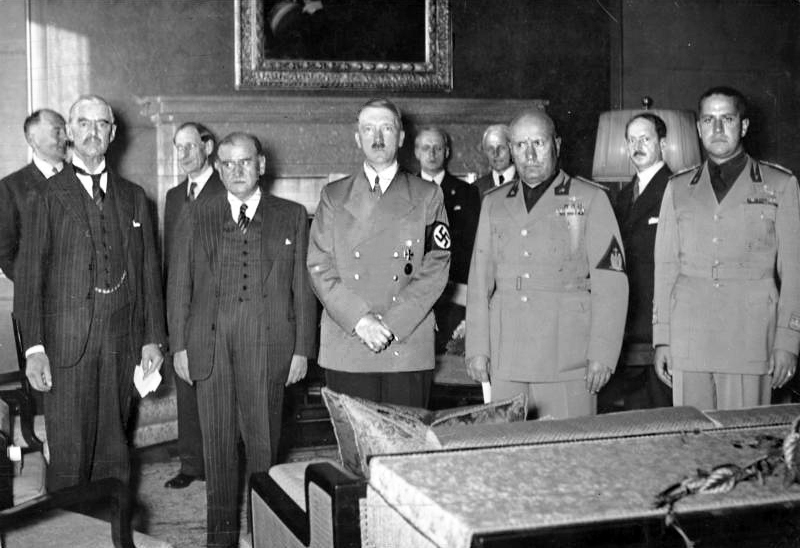

The lesson for today's Western leadership should be obvious. An agreement that rewards aggression does not necessarily end a war. It can simply establish the conditions for the next one.
What Capitulation Means
The message to the West is much like the message Ukrainians must hear today: do not be fooled. Remember what is happening in the occupied territories. Remember what occupation looks like. Destruction alone is not enough to describe it. It is the removal of children from their families, the imprisonment of teachers, the replacement of Ukrainian textbooks, the persecution of those who speak Ukrainian, and the elimination of anyone who refuses to accept the authority of the occupying state. It is the systematic effort to make a Ukrainian child believe that their history, language, and identity are illegitimate. It transforms ordinary life into an act of resistance. An embroidered shirt, a bandura, a Ukrainian poem, or simply the refusal to accept a Russian passport can become grounds for persecution. For some, it means a bullet to the back of the head. For others, it means imprisonment, torture, deportation, or a slow death through starvation. These are not abstractions. They are the lived experiences of Ukrainians who have been unfortunate enough to find themselves under Russian occupation.
And this is what capitulation means.
It means telling these people that their suffering is an unfortunate but acceptable consequence of negotiations. It means asking them to trust a government that has already demonstrated what it intends to do with their communities. It means expecting Ukrainians to surrender their homes, their history, and their children to an occupying power in exchange for promises that history has repeatedly shown to be worthless.
The Diaspora's Responsibility
This responsibility also belongs, in particular, to those of us living in the United States. We cannot commemorate the Holodomor with speeches, candles, and memorial services while simultaneously remaining passive when its underlying methods are being employed against Ukrainians today. Commemoration without action risks turning historical memory into a ritual devoid of political meaning.
The Ukrainian diaspora was built by people who understood what it meant to lose their homeland. Generations of Ukrainians arrived in America carrying memories of war, occupation, famine, and political persecution. They established churches, cultural organizations, schools, newspapers, and political institutions because they believed that Ukraine would one day be free. Their work was never meant to end with preserving Ukrainian embroidery, food, music, and folklore. It was intended to preserve the Ukrainian nation itself.
We owe those generations more than remembrance. We owe them the continuation of their struggle through political organization, public advocacy, and defending an independent Ukraine. For Ukrainians, the question is even more immediate: can we afford to believe that an occupying empire will suddenly become a guarantor of our freedom?
We Know What Happens Next
We already know what happens next.
The Holodomor taught us what happens when Moscow is given control over Ukrainian lives, Ukrainian resources, and Ukrainian futures. The destruction of the Ukrainian intelligentsia taught us what happens when a nation is disarmed politically and culturally. The experience of generations living under occupation taught us what happens when the world decides that Ukrainian independence is negotiable.
We must not allow those lessons to become historical footnotes.
Ukrainians will not, and should not, forget the certainty that anything less than a just and lasting victory brings: the return of terror, the destruction of national life, and the possibility of another Holodomor.
There can be no lasting peace built upon the starvation, imprisonment, deportation, or erasure of the Ukrainian people. There can be no Ukrainian freedom under Russian occupation. And there can be no honest commemoration of the Holodomor if we are unwilling to defend Ukrainians from the same imperial logic that made it possible.
We know what happens next. We must not allow it to happen again.