
Polish Foreign Minister Sikorski:
"We have been thinking about our security in relation to Russia for about five hundred years, and we are not going to stop. Throughout history, Russia has invaded Poland many times. When the Russians threaten us, we take those threats seriously. However, today Putin has no means to attack us. At most, he is capable of attempting some kind of provocation. He still hasn't managed to seize the Donbas, despite almost thirteen years of trying.
"After the war stops"
All current forecasts about a possible attack by Russia on EU countries keep running into the same caveat — "Russia will be ready to attack in X time after the war in Ukraine ends"
A few examples:
- The German Council on Foreign Relations (DGAP) points out that the countdown to a possible attack on NATO (5–9 years) will only begin after the end of intensive combat operations in Ukraine (or a freezing of the conflict), since this would free up resources and give Moscow a breather to rebuild its ground forces:
"Once intensive fighting in Ukraine ends, Moscow may need just six to ten years to rebuild its armed forces" (DGAP Policy Brief)
- Estonia's Foreign Intelligence Service, in its 2024 report, directly notes that an attack on the Baltic states is highly unlikely in the short term precisely because Russian resources are fully tied up by the war in Ukraine:
"A direct military attack on Estonia or the Baltic states in the near term remains highly unlikely, primarily because Russia continues to focus its main attention on the war in Ukraine" (Estonian Foreign Intelligence Service)
- The Institute for the Study of War (ISW) emphasizes that a halt in fighting is a necessary condition for Russia to be able to redirect resources from the front toward reforming and preparing for an attack on NATO:
"A ceasefire would allow Russia to redirect personnel, industrial capacity, and resources from meeting urgent operational needs in Ukraine toward large-scale measures to expand and reform… in order to prepare armed forces better suited for subsequent operations [against NATO]" (ISW: The High Price of Losing Ukraine)
Since the Russo-Ukrainian war, despite an obvious stalemate on the battlefield, does not look close to ending, I asked myself: "Were there historical cases where a country exhausted by a long war against a fairly weak opponent started a new war against a stronger opponent?” Such an outcome seems utterly improbable and absurd, so it became interesting to find counterexamples to the basic intuitive answer to that question.
This Isn't Spain, It's China
Pro-Ukrainian leftists such as Paul Mason often compare the Russo-Ukrainian war to the Spanish Civil War. The parallel is understandable — a regional conflict that became a kind of rehearsal for the coming world war. Ukraine also fits this narrative well.
But in other respects it's not very similar — in Spain the conflict had an internal nature, and in many ways it truly was the proxy war that Russian propaganda now tries, in a caricature form, to portray the war over Ukraine as.
If we set aside our Eurocentrism and look at the history of the interwar period, we see a far more relevant example.
So, the 1930s: Japan. Having survived the collapse of an empire isolated from the outside world, Japan opened up to the world and rapidly modernized. However, this was not accompanied by democratization, and gradually — especially after the global crisis — power was seized by security-force elites oriented toward isolationism.
They painfully perceived the loss of their former greatness and began openly claiming full dominance over the entire geographic region, treating the influence of other states as an existential threat.
It all started with a harsh “saber policy” in occupied Korea and an attempt at its full assimilation. But the main object of Japan's ambitions became China. Back in the 16th century, Toyotomi Hideyoshi — the unifier of Japan — had proposed making China, Korea, and Japan “a single whole.”

China had long been under strong Japanese influence, and by the 1930s, in Japanese eyes, it was completely destroyed from within. Tokyo considered China not a sovereign nation but a “geographical concept” — a collection of warring warlords who hated each other more than they hated the Japanese. After the revolution, central power there was in decline, and there was, in places, violent civil confrontation between nationalists, communists, and local militarist regimes.
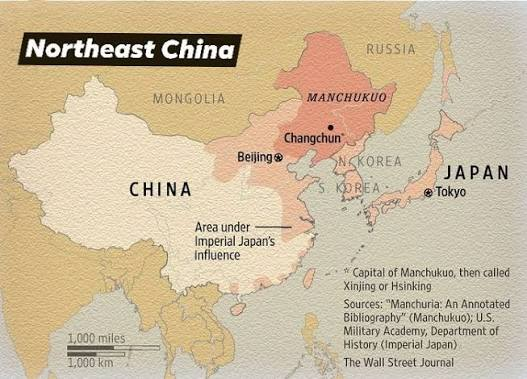
Taking advantage of this, Japan, in 1931, using a fabricated pretext, occupied Manchuria, practically without resistance. It organized a puppet state there, Manchukuo, and begins to militarize the region more and more.
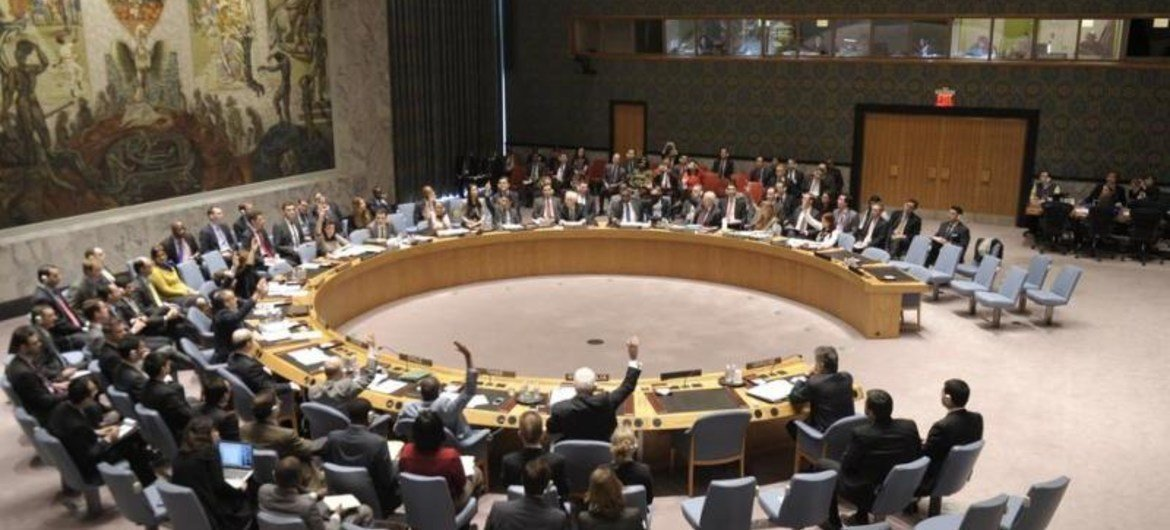
The world community tried to shame Japan, appealing to international law. The Japanese government responded simply by declaring that the West understood nothing about the specifics of the Far East. In February 1933, the Japanese delegation demonstratively walked out of the League of Nations assembly hall in front of the cameras. Today the occupation of Manchuria is considered the first event to undermine the prewar system of collective security, and one that showed Mussolini and Hitler that the League of Nations was unable to protect anyone.
Then came 6 years of “peace,” constantly interrupted by small clashes on the new border. All this time, Japan sought to undermine China politically. To this end, Japan hunted for various Chinese collaborators to work with and to assist certain autonomous Chinese governments friendly to Japan. This policy was called the “specialization” of North China, also known as the “North China Autonomous Movement.” In [19]35, China, under pressure, signed a normalization agreement that in fact handed North China over to Japanese control.
But this was not enough for Japan — after the Marco Polo Bridge Incident in 1937, Japan began a full-scale invasion of China. The main goal was the overthrow of the Kuomintang government and the establishment of its own puppet government, the placement of its military bases on Chinese territory, and the disarmament of the Chinese army, as well as the complete elimination of any anti-Japanese or communist activists.
It's important to understand that, despite such sweeping goals, Japan was not planning a big war — this was in large part the adventure of a particular faction of the security elite. The operation was planned to be very fast, just a few weeks (three months at most). The plan largely relied on a swift decapitation operation to seize the country's elite in the capital and crush its best army formations. After that, China was supposed to request capitulation on its own. The unwillingness to admit that the country had gotten into a major war was reflected even at the level of discourse — the war was never called a war, even when the troop grouping reached a million men; officially it was just the “China Incident.”
Of course, everything immediately went off plan. The first major battle took place in Shanghai — one of China's largest and most important port cities. Japanese forces got bogged down in bloody, protracted urban fighting. The Chinese fought while almost fully surrounded.
On the one hand, at Shanghai, China lost some of its best troops, trained by German instructors, which would go on to have negative structural consequences for the Chinese army. In part, the attempt to hold the city at any cost was explained by the expectation that the Western powers would pressure Japan and force it to halt the invasion. Even though the “Nine-Power Treaty” guaranteed China's rights to sovereignty and territorial integrity, the Western powers in fact did nothing beyond moral condemnation of Japan.
Despite all this, the Battle of Shanghai, in which Japan lost 70,000 men, was a “cold shower” for them. The Chinese did not run or surrender as Japan had planned — they fought for every meter of their territory. The Japanese army's next target became Nanjing, the capital of China. At the same time, the first attempt at peace negotiations took place, mediated by Nazi Germany. But it failed. At first, China was skeptical because it expected Western support soon. And then the Japanese burst into Nanjing and carried out a massive massacre there, which made the war existential for the Chinese and effectively completely destroyed the Chinese "peace faction" politically. The Japanese, for their part, declared outright that they did not consider Chiang Kai-shek's government legitimate and would wait until another government appeared in China.
The fall of the capital did not lead to capitulation — the government fled to Wuhan, and after its fall, to Chongqing. By that time, the Japanese forces had suffered enormous losses, both from fighting and from disease and logistical problems. By the end of 1938, active offensives by the Japanese army ceased, and Japan bet on political pressure against the Chiang Kai-shek regime, through attempts to break China's internal unity and form an "Other China" out of collaborators. It was then, in the private diaries and backroom discussions of the Japanese elite, that the term doronuma (bog, quagmire) appeared — this is how Japanese generals described the deadlock they found themselves in.
Many then realized that the words of Lieutenant General Ishiwara Kanji, the chief strategist of the Japanese army, had been prophetic:
If we continue our full-scale offensive into the interior of China, this will become our Spain [a reference to Napoleon's catastrophic campaign that exhausted France]. We will get bogged down in an endless quagmire (doronuma) that will devour all the Empire's resources and leave us utterly defenseless against our true enemy — the Soviet Union.
Ishiwara was not heeded, and in September 1937 he was scandalously removed from his post for "defeatism."
Fumimaro Konoe, who held the post of Prime Minister at the outbreak of the war (1937–1939), bitterly noted in his memoirs and personal notes, written before his suicide in 1945:
The China Incident, from the very start, developed nothing like what the Army had promised me. With every month it turned more and more into a deadly quagmire from which the government proved powerless to extricate itself. Any of our attempts to start peace negotiations were torpedoed by the local command, which demanded ever more offensives to "save face"
It is worth separately mentioning the international aspect. Initially, the main donor of aid to China was the USSR — it massively supplied weapons, military advisers, and even pilots. However, after the rapprochement with Germany and the start of the Soviet-Finnish war, Soviet aid began to decrease. In anticipation of war with Germany, the USSR decided to secure its eastern flank and fully normalized relations with Japan, fully recognizing Japan's conquests in China and completely winding down any aid.

China also relied on purely commercial arms purchases from France, England, and the US, which traveled by various routes — but mostly through British and French colonies. In turn, the US helped with loans, but only for non-military needs. Japan's inability to turn the tide of the war against what seemed like a weak opponent produced cognitive dissonance among the Japanese elite. According to the racial and military ideology of the time, the Imperial Army, endowed with the "spirit of Yamato," simply could not be tied down for so long by an "underdeveloped and chaotic" opponent. All this led to a fundamental shift in Japanese rhetoric and strategy.
A statement by the Japanese Foreign Ministry from 1940 read:
The blind and stubborn capacity of the Chiang Kai-shek regime to resist is sustained solely by the assistance of the United States and Great Britain. Were it not for their constant infusions of capital and war materiel, this anti-Japanese regime would have collapsed long ago, and peace would have reigned in East Asia
Later this concept crystallized into a full-fledged theory of ABCD encirclement (America, Britain, China, Dutch). For example, Hideki Tojo (War Minister, and later Prime Minister), speaking at an Imperial Conference on November 5, 1941, said:
The United States and Great Britain, in collusion with the Dutch, are doing everything they can to obstruct a settlement of the China Incident. They are tightening the economic blockade and drawing the ABCD encirclement ring around our Empire. [...] Our Army has already been shedding blood on the continent for four years, but because of Washington's interference, which uses Chiang Kai-shek as its vanguard, the fruits of our victories are reduced to nothing. We must break this ring
Accordingly, Japan's military and political strategy became entirely focused on trying to cut China off from the outside world. Since the arms supply routes to China ran through the territories of the British and French colonial empires, this pushed Japan more and more toward confrontation with those countries. In Japanese staff documents, a special term appeared: "Ensho Ruto" (援蒋ルート) — "The Routes of Aid to Chiang."
Japanese strategists decided that they needed to "fell the tree by cutting its roots." A chain of operations began:
- Southern China (1938–1939): The Japanese land on Hainan Island and capture the port of Guangzhou (Canton), not to conquer the south, but solely to cut off supplies via Hong Kong.
- French Indochina (1940): After the fall of France, the Japanese invaded their colonial possessions with one goal — to cut the Haiphong–Kunming railway, along which French and commercial weapons were traveling.
- The Burma Road (1940): This became an obsession in Tokyo. In 1940, Japan, under threat of war, forced Great Britain to close the Burma Road for three months.
All this only led the Western allies to strengthen their support for China — President Franklin Roosevelt began imposing harsh sanctions on Tokyo (an embargo on scrap metal, and later on oil). In the spring of 1941, Roosevelt extended Lend-Lease to China. American weapons began arriving via the Burma Road. The American Volunteer Group (AVG) also arrived in China under the command of Claire Chennault — the famous "Flying Tigers." In effect, the Western allies replaced the lost Soviet support.
At the same time, despite Japan's growing appetite for confrontation with opponents far stronger than China, the Japanese army and economy were not becoming stronger over time. In 1937, the Japanese army was one of the most professional in the world. The Chinese "quagmire" ground down this professional core in the very first months of the war. Older-age reservists and hastily trained young men were mobilized en masse to replace them. Because of the stretched-out lines of communication, soldiers went months without proper supply, fell ill with tropical diseases, and turned into ragged wrecks. This led to a catastrophic collapse in morale and widespread looting (which the command began to tacitly encourage, since it could not feed the troops).
General Yasuji Okamura, commander of the 11th Army (later Commander-in-Chief of the China Expeditionary Army), after inspecting the troops, bitterly wrote in his diary:
On arriving at the front, I was struck by the decline in discipline and morale... The true reason lies in the fact that the war has dragged on. The soldiers are physically exhausted, their nerves worn out by endless fighting in a foreign country with no clear goal and no hope of returning home soon. Looting, arson, and violence became for them a way to relieve the stress of this hopelessness.
Prince Mikasa (Takahito), the younger brother of Emperor Hirohito, who served as a staff officer in China, later recalled this period with horror:
Some of our officers used Chinese prisoners as live targets to train recruits in bayonet fighting... I saw an army that had lost its human face and its chivalrous spirit, an army that, out of despair, had descended into barbarism.
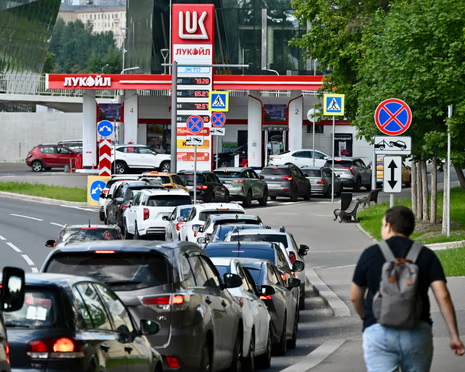
The economy, battered by war and sanctions, was also falling apart. In 1938, the government passed the "National General Mobilization Law," which effectively abolished capitalism and shifted the country onto the tracks of a rigid command economy. The civilian sector was destroyed for the sake of military needs. Japan encountered a phenomenon called the "economy of substitutes" (ersatz goods) — the replacement of quality materials with cheaper analogues. The Japanese government tried to conceal the economic catastrophe behind loud slogans. The most popular official posters of 1939–1940 were: "Luxury is our enemy!" and "We will want nothing until we win!"
But reality was grim. The well-known Japanese liberal journalist Kiyoshi Kiyosawa, in his secret "Diary of Darkness," recorded the mood of a society exhausted by endless victory bulletins amid poverty:
Yesterday we stood in line for matches. Today there is no rice or sugar. The streets of Tokyo are full of widows in mourning and cripples... Prices rise every day. And yet the radio keeps shouting about our "brilliant victories" on the continent. We win every battle on paper, but our country is slowly dying of exhaustion.
Parallel Lines
Thus Japan found itself in a situation quite similar to the one Russia finds itself in today. Weakened by war, embittered against its enemy's allies, stuck in a trap, unable either to achieve decisive victory or to back down.
It's interesting to trace how the Western powers of that time perceived Japan's position, in order to compare it with today's talk about Russia balancing between "Russia is extremely dangerous for Europe" and "Russia is very weak and cannot achieve success even against Ukraine."
On the one hand, everyone understood that Japan's strategy was leading it more and more toward confrontation with the Western powers, and a possible war was no surprise. Historian Roberta Wohlstetter, in her classic work Pearl Harbor: Warning and Decision, wrote:
Rarely has a government been in greater anticipation [of war]. We were simply waiting for the wrong thing... We became so absorbed in thinking through the "obvious" Japanese moves that we failed to hedge against the choice they actually made.
There was also direct evidence of specific military plans. The American ambassador to Japan, Joseph Grew, who had spent ten years there and had an excellent network of informants, constantly sent alarming reports to Washington. Back in January 1941 (almost a year before the attack), Grew sent a telegram to the State Department:
A Peruvian colleague told a member of my embassy staff that he had heard from many sources, including Japanese military circles, that in the event of a conflict between the US and Japan, the Japanese plan to begin it with a sudden massed attack on Pearl Harbor.
On the other hand, this scenario seemed quite improbable — for a Japan exhausted by the war in China, opening new fronts against far stronger opponents seemed like suicide.
The chief architect of the tough US policy toward Japan was Stanley Hornbeck, chief adviser on the Far East to Secretary of State Cordell Hull. Exactly 10 days before Pearl Harbor, he wrote:
There is no one in the Japanese government or army who wants war with the United States. Given their deep exhaustion in China, I am ready to bet five to one that Japan will not start a war against us, not today, not in the foreseeable future.
In Britain they were even more confident in their own superiority. Winston Churchill (in a letter to Roosevelt, summer 1941):
Nothing sobers the Japanese mind quite like the sight of heavy British battleships. I doubt Japan will dare to declare war on the British Empire and the United States simultaneously. If they do, an inevitable and swift collapse awaits them.
General Douglas MacArthur (Commander-in-Chief of US forces in the Philippines, November 1941), at a meeting, declared:
Japan simply doesn't have the resources to carry out a large-scale coordinated offensive to the south. I sincerely believe they will not attack. And if they try to poke their nose into the Philippines, my B-17s will turn their fleet to dust.
Public commentators and journalists held the same view. Time magazine, in the spring of 1941, reflecting the consensus of American analysts, wrote:
The Japanese army is an army that in four years has failed to defeat even China, a country without heavy industry and without modern weapons... This army is worn out, its equipment is five years out of date, and its soldiers are malnourished. It has no chance whatsoever against the modern might of the West.
An American observer of the war in China drew this conclusion in a memorandum for the Pentagon:
Japanese frontal attacks and flanking maneuvers, so successful against poorly armed and disorganized Chinese troops, would amount to mass suicide when pitted against the modern firepower of a first-rate Western opponent.
The official British Army handbook on the Japanese army went even further:
One of the main tendencies of the Japanese is a bent for "imitating rather than creating," which makes them a less dangerous opponent than the more "original" European armies... When faced with a modern army belonging to a first-rate power, they do not pose a serious threat.
It became commonplace to perceive the Japanese as a weak nation in decline, trying to appear stronger than it really was.
Robert Craigie (British Ambassador to Tokyo) put it well in a dispatch to London in 1940:
The Japanese, as a nation, have the typical mentality of a bully. They immediately back off when shown a fist, and start acting up if they see even the slightest sign of compliance. A firm stance by the Anglo-Saxon powers will make them tuck their tail between their legs.
Causes and Consequences
The Allies' assessments, in hindsight, may seem absurd — and I haven't even mentioned the openly racist clichés of Western military men, who claimed the Japanese couldn't be good pilots because of the shape of their eyes.
However, at the time, it was hard to argue with the general thrust of this thinking — Japan was mired hopelessly in China (a weak and backward country), its economy was in ruins, and it was, moreover, heavily dependent on oil imports from the US.
It's important to understand that, even though the US today is objectively the strongest country in the world by many measures, back then the gap between Japan and the US was simply staggering. The US produced tens of times more military equipment than Japan; its economy was tens of times larger than Japan's. From an accounting standpoint, the US and Japan were simply incomparable. The idea that Japan would decide on a war against such a powerful opponent seemed absurd — and even if it did, it would hold out no more than a few days.
So what were the reasons for such seemingly suicidal behavior?
A fairly substantial part of the historiography largely reduces the reasons for this decision to the US oil embargo. Japan was totally dependent on oil and imported most of it from the US. The embargo imposed in 1941 confronted Japan with a stark choice — either meet US demands and leave China, or try to force the US, by force, to abandon the idea of the embargo and compel it to negotiate. Moreover, an advance to the south and the seizure of Southeast Asia could give the Japanese access to Indonesian oil.
In this framing, the US was too overconfident and backed Japan into a corner from which it saw no way out except a big war.
However, historian Michael Barnhart, in his book Japan Prepares for Total War: The Search for Economic Security, 1919–1941, calls this widespread narrative into question. The very course toward building the so-called Greater East Asia Co-Prosperity Sphere in Southeast Asia — that is, a purely Japanese sphere of influence — made a future war with the US inevitable:
The Pacific War was, in its essence, a conflict between two visions of East Asia. Each vision had a strong economic element. Japan's fundamental military goal was to create a Greater East Asia Co-Prosperity Sphere as a self-sufficient and powerful unit with the Japanese Empire at its center. American ideals in trade and governance (and American treaty rights in China) directly contradicted the Japanese ones. Out of this contradiction grew a complex relationship that gradually became more and more hostile. This was bound to culminate in the attack on Pearl Harbor
A separate factor is that even if the US had not imposed the embargo, the very dependence of Japan on American oil was, for the isolationist Japanese elite, an absolute nightmare in itself:
The possibility that the Americans might supply Japan with just enough oil, steel, and other materials to maintain a half-starved existence was unbearable for any Japanese statesman. Absent a fundamental solution, then, war was the only path left open. On the one hand, Japan could have abandoned all attempts to achieve self-sufficiency... But all the factors discussed in this book made such an outcome highly unlikely. On the other hand, Japan could genuinely achieve self-sufficiency by creating a great Asian empire and challenging the West in an attempt to overthrow it
Another important aspect is the time factor. In many cases, even when the underlying factors point to the inevitability of war, the task of diplomacy is to delay its start as much as possible. Often, dragging out time leads both sides to reassess the risks and quietly abandon their plans. In Japan's case, however, the war in China was a factor that made it necessary to make a decision as soon as possible.
On the one hand, Japan kept losing resources in the war with China — this war was like a quagmire, draining strength from the army and the economy. On the other hand, the US kept ramping up the pace of weapons production and army modernization:
Naval leaders were awed by the grandiose scale of American shipbuilding plans, but could hardly bring themselves to admit that they had no chance of a successful encounter with the US Navy.
Barnhart also notes that the Japanese fleet vitally needed enormous new resources in order to "attempt to keep pace with the Americans' gigantic naval construction programs."
In July 1940, the US Congress passed the "Two-Ocean Navy Act" (Vinson-Walsh Act). This was an unprecedented shipbuilding program meant to increase the size of the US Navy by 70%, adding dozens of new carriers, battleships, and cruisers to the fleet. The Japanese estimated that by 1943–1944, once American shipyards launched the ships from the new program, the US would outnumber Japan by a factor of 2–3.
Admiral Osami Nagano (Chief of the Naval General Staff) reported directly to the Emperor: delaying the war meant guaranteed defeat. Time was working against Japan with every passing day — Japan would only grow weaker, while the US grew stronger and stronger.
Everyone could see this in general, not just the Japanese, which is why US strategy, too, was largely aimed at dragging out the negotiation process, postponing the war. But there was a factor that no one saw except the Japanese. While the world saw only Japan's vulnerability in the war against China, the Japanese also saw in it their own advantage.
By the end of 1941, the Imperial Army had already been fighting in China for more than four years (and in Manchuria for a full ten). Japanese soldiers were battle-hardened veterans, accustomed to grueling forced marches, meager supplies, and fighting in difficult terrain. The war in China became an ideal training ground for Japanese naval and army aviation. Japanese pilots had hundreds of hours of real combat sorties behind them.
This experience gave the Japanese confidence that the most complex simultaneous operations (the strike on Pearl Harbor and a blitzkrieg through the jungles of Southeast Asia) would succeed. But they understood that this advantage was temporary. If the Americans were given time to train their army, this qualitative gap would disappear.
Subsequent analysis by American historians showed the full validity of these expectations:
Four years of constant joint action against an active enemy on the coasts and rivers of China gave both services enormously valuable experience, which was successfully applied in the planning and organization of joint expeditionary forces. Matters of command, supply, and other details had been carefully worked out in advance and were clearly understood by all parties concerned
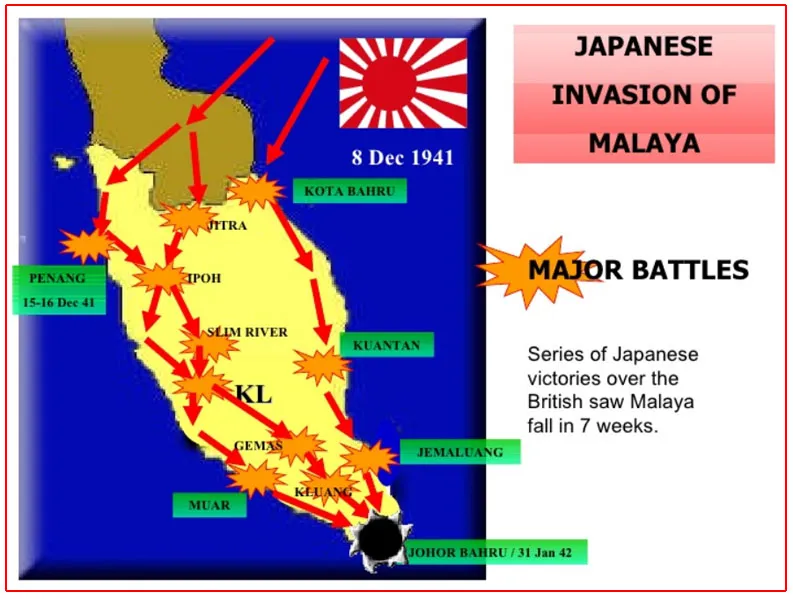
The Japanese Campaign in Malaya: December 1941-February 1942
Mark Peattie, in his book on the development of Japanese aviation, also confirms this:
It was the skill of Japanese fighter pilots, honed in aerial combat over China from 1937 to 1941, no less than the superiority of Japanese aircraft such as the Mitsubishi Zero, that provided the confidence behind the aggressive actions of Japanese aviation in the first six months of the Pacific War
Sunburst: The Rise of Japanese Naval Air Power, 1909-1941, Mark R. Peattie
The protracted war with China itself transformed the entire mode of thinking of the Japanese military. They understood it not only as an advantage in war-fighting experience and understanding of tactics and strategy — but also as a factor of moral superiority. Colonel Masanobu Tsuji (the chief planner of the Malayan operation and the assault on Singapore) directly compared the spiritual and physical toughness of the Japanese with the Western mentality. He noted:
Our frank thinking at the time boiled down to the idea that the Americans, being merchants, would not wage a costly war for long, whereas we ourselves were capable of waging a protracted one.
The Japanese elite sincerely believed its own propaganda that the US and Great Britain were societies of "merchants" who evaluated war as a business project. By their logic, as soon as this "project" started producing excessive losses (in the form of sunken ships and thousands of soldiers killed in distant jungles), the pragmatic Americans and British would simply cut their losses and sign a peace treaty, leaving Asia to the Japanese.
Historian John Dower explains how Japanese propaganda convinced the population that Western soldiers were simply incapable of enduring hardship:
Nationalist propaganda portrayed Western culture as soft and enervated, and the average American and Englishman as too selfish to sustain a long war in a distant place.
The Leap From the Kiyomizu Temple Terrace
A clash between two fundamentally incompatible views of how the region should be ordered, combined with harsh time pressure on one of the sides, became a recipe for a war that seemed almost practically impossible. Historical parallels cannot serve as proof, but they teach us to look at a situation more broadly — logic that seems utterly airtight can turn out to be extremely shaky once we start testing it against historical material.
For example, the currently widespread idea that Russia could attack EU countries only after the war in Ukraine ends starts to look very doubtful once we look at the experience of the Sino-Japanese War. Japan did not try to end the war with China because it understood two things:
- Even if China agreed to a truce, it would certainly not observe it in the event of a war between Japan and the US. China would, one way or another, take advantage of the diversion of Japan's forces and, moreover, would receive stronger support from its allies
- At the same time, China was not dangerous enough to require keeping all the troops that had been used against it in order to contain it
Broadly, the same situation is unfolding now in the Russo-Ukrainian war. Even if Russia agrees to a truce with Ukraine, it will still, one way or another, have to keep significant forces on the border with Ukraine, and in the event of any escalation with Europe, the Ukrainian front will inevitably reopen. This is understood in the Kremlin, and it is understood in Ukraine. So it's rather strange to tie the threat of an attack on EU countries to the end of the war with Ukraine — if the Ukrainian front is a powerful deterrent factor for Russia, then it would be correct to say that Russia will never be able to attack Europe as long as Ukraine exists.
On the other hand, all European experts look at the Russo-Ukrainian war as a pure stalemate — a deadlock with no way out for either side. The probability that Ukraine or Russia will break through the front and achieve a decisive victory is estimated at close to zero. From this, a conclusion about Russia's weakness is often drawn. But in doing so, people forget that this also means that even if Russia pulls some forces off the Ukrainian front and redeploys them to Europe, that would not lead to the instant collapse of the Russian defense.
The whole construction of "Yes, Russia is a threat to Europe, but only after the war with Ukraine" collapses the moment we simply start comparing the very facts underlying it. This construction can only exist thanks to the "doublethink" of European politicians — in which, on the one hand, Ukraine is not strong enough to achieve a substantial breakthrough even if Russia weakens, and, on the other, Russia cannot pull forces off the Ukrainian front without risking its collapse. These positions are not logically compatible, but they coexist in political logic simply because they help sustain a convenient narrative both for voters and for the EU elites.
Political doublethink lay at the heart of Britain's strategy of containing Japan, as Orwell wrote in his well-known essay "In Front of Your Nose":
"Hong Kong. Long before the war, everyone acquainted with the situation in the Far East knew that our position in Hong Kong was untenable and that we should lose it as soon as a major war started. This knowledge, however, was intolerable, and so successive British governments continued to cling to Hong Kong instead of giving it back to the Chinese. Even worse, right up to the outbreak of the Japanese war, fresh troops were still being poured into the doomed fortress. The war came, and Hong Kong duly fell, as everyone had known that it would."
Japan saw no other path for itself besides full-scale war, while the Western powers, on the contrary, entirely ruled out that option, allowing only for local clashes. This contradiction is explained by the fact that Japan had already been living, for a long time, in a full-fledged war, while the US and Britain still largely thought in peacetime terms. Their thinking was, in many ways, accountant-like, resting on a comparison of the resources available to each country. There was a grain of truth in Japanese propaganda's claim that Americans think like financiers. But this is a characteristic of the civilian approach to management in general, not a specific feature of Americans.
The point is that in civilian management, two of the most important categories — time and risk — do not play the role they play in military management.
Time
In civilian management, time does not affect the quantity of available resources. If you need to unload a train, that can be done by 1 person in 10 days or by 10 people in one day. This is where the unit of labor known as the man-hour comes from. Of course, this is a convention, and in reality, productivity falls as the number of people grows.
But we can flexibly allocate resources over time — speeding up or slowing down the pace of work as needed. A project can be broken down into abstract units of required resources, whose use can be used to gauge progress. You can picture a project as a jar into which we drop resources — as soon as it's full, the project is done.
In war, time works differently — using resources in the wrong time frame can produce a zero or even negative result. Describing one of the most nightmarish and disastrous amphibious operations in history — the battle for Gallipoli — Churchill wrote:
Force and time are almost interchangeable in operations of this character, and each can to a very large extent be translated into terms of the other. A week lost was equal to a division. Three divisions in February would have overwhelmed the Gallipoli Peninsula with a very small loss of life. Five in April would have made certain of success. Seven would probably have done it in June or July. Nine might have succeeded in August. Fourteen were not enough in the end.
Sharpening our Military Command Part III: Why time is the most valuable military resource
War devours resources — applied at the wrong time, they don't move you toward your goal; they simply exhaust you.
This is the main reason why the accountant's approach to assessing the balance of forces simply doesn't work. What matters is not how many resources you have and how many your opponent has — what matters is the speed at which you can apply them.
Every time you hear European politicians say that Russia's GDP is no bigger than Italy's, you're seeing an example of people with civilian mindsets failing to understand how resources work in war.
The Western allies had exactly the same mindset before the war with Japan. They saw that Japan was many times weaker than the US and Britain by every measure — military, economic, resource-based. But, unlike Japan itself, they did not understand that having a fully mobilized, experienced army and an economy put on a war footing allowed it to apply its extremely limited resources within a compressed timeframe, thereby creating an advantage in strength.
The same logic applies to Russia today. Its army has valuable tactical experience, Russia itself has built a system of mobilization and recruitment, and its economy is fully subordinated to the needs of the war. Meanwhile, European countries still live under peacetime laws, which impose a host of restrictions on them. This makes it impossible to disperse troops and build fortifications or minefields wherever military necessity requires rather than wherever it's possible from a legal and political standpoint, and makes it impossible to effectively use air defense and aviation because of civilian activity in the airspace. All of this creates an enormous asymmetry between Russia's and Europe's capabilities.
Risk
In civilian projects, the main rule is to reduce risk, even at the cost of abandoning part of the objectives, extending deadlines, and so on. The less risky your plan, the better it is, and the more benefit it will bring. Entire departments and procedures are built around minimizing risk — and sometimes this goes too far and starts affecting efficiency, but on the whole the general rule remains: lower risk is always better.
In military affairs, it's largely the opposite — plans that aren't ambitious and risky enough are, as a rule, doomed to fail from the start. Almost every operation that looks today like a pinnacle of military success actually depended on a lucky turn of events — one that might not have happened.
A classic example is the swift conquest of France by German forces in 1940. This entire operation depended on the Germans' ability to defend a single bridge over the Meuse River:
On May 14, nearly six hundred Panzer tanks passed through this needle's eye. This meant that the success of an operation carried out under enormous time pressure largely depended on this one single bridge. It acquired an operational significance unlike any other bridge during the Second World War. In this sense, it also symbolizes the risky gamble that Hitler's adventurous military policy forced his generals to take.
This last sentence is especially fitting, since it highlights the difference between the German and Allied approaches to this battle: the Germans took a big risk. Risk makes you more vulnerable to chance (or to luck). But risk is a double-edged sword: luck can be on your side, or it can turn against you. Nevertheless, from the German point of view, this made sense. The Allies outnumbered the Germans at the start of the offensive, even though common sense dictates that you should outnumber your opponent three to one. So you have to win the battle by outsmarting your opponent, which means speed and time are your most important assets. Speed and time require risk at every level. After the capture of Hill 301, the German officer Black said: "What is easy today may cost us rivers of blood tomorrow."
The Allies understood that this one single bridge could change the course of the battle, and possibly the whole war. So they threw all their air power against this one bridge. Unfortunately, having already lost many aircraft in the preceding days, on May 14 they were able to muster (only) 152 bombers and 250 fighter sorties.
But the Germans had foreseen this back at the planning stage of the operation. Since their bridges were the Achilles' heel of the entire operation, they were prepared for it. Never before had such a large number of anti-aircraft guns been massed — a total of 303 anti-aircraft guns. While the Allies fielded around 250 escort fighters, the Luftwaffe flew 814 sorties.
The Allies bombed the bridges with everything they had, but kept missing. One desperate pilot even tried to crash his burning aircraft into the bridge, kamikaze-style, but missed. This may indicate that for the Germans this was not an unforeseen risk but rather a calculated one. Even so, despite the fact that the number of fighters and anti-aircraft guns favored the Germans, the Allies only needed to drop a single bomb on the target — just one bomb. In theory, they had at least 152 aircraft capable of dropping that one bomb on that one bridge, and hence at least 152 attempts. Even if the Germans had managed to build a second or third bridge, the odds would still have been unfavorable. I'm inclined to think the Germans got lucky that day.
Warriors' fortune: Part I How luck plays an important role in war, and how to deal with it.
This is largely tied to how time works in war — the need to use resources within strictly limited time frames is always bound up with enormous risk; but by refusing to accept that risk and trying to reduce or "hedge" it, we can walk straight into defeat. In many ways, a mirror image of the German operation is the Allied operation "Market Garden," which had a real chance of ending the war as early as 1944, but failed and became a textbook example of military failure. The planners of this operation have very often been accused of disregarding risk. But more recent research shows the situation is, in many ways, the opposite:
If Operation Market Garden had a structural flaw, it lay not in the plan itself but in the logistical system that was supposed to support it. By September 1944, Allied supply lines stretched for hundreds of miles back to the Normandy beaches, straining under the demands of armies that had advanced far faster than pre-planning had assumed.
The port of Antwerp, captured intact through a remarkable coup by the British 11th Armoured Division, was not yet operational, since German forces still controlled the mouth of the Scheldt and could deny Allied shipping the use of it.
Eisenhower's broad-front strategy — the decision to advance simultaneously on several axes rather than concentrate all forces on a single thrust — meant that scarce fuel, ammunition, and supplies were split between competing army groups, each with solid arguments for priority. Patton's Third Army in the south was advancing rapidly and needed resources. Bradley's 12th Army Group had its own needs.
Under these conditions, Market Garden did not have the logistical base it needed to carry out its breakthrough project. This is, crucially, a structural critique of Allied strategy as a whole, not of Operation Market Garden as a specific operation. The broad front chosen by Eisenhower was the subject of fierce debate among Allied commanders throughout the autumn of 1944, and that debate has continued among historians ever since. Montgomery argued passionately, even excessively so, that concentrating all available resources on a single powerful thrust was the correct strategy. Operation Market Garden was, to a large extent, his attempt to demonstrate this logic by forcing a concentration of effort in the north. Blaming the operation's failure partly on inadequate logistical support paradoxically confirms his central strategic argument. The resources weren't there because they were spread too thin. The operation failed, in part, for exactly the reason Montgomery had warned about.
In Defense of Operation Market Garden: A Bridge Too Far? Or a Bridge Too Far!
In other words, the logic of risk diversification that is classic for civilian management tends, in war, merely to waste resources. Almost any successful planning necessarily involves accepting serious risk.
It is precisely this view of risk that lets us better understand why Russia chose a full-scale war against Ukraine instead of a limited operation in the Donbas. Despite the higher risk, this strategy made it possible to use Russia's strengths — such as prepared and pre-positioned troops, an advance across territory with a weak system of fortifications, powerful airborne capabilities, and the ability to rapidly move troops deep into enemy territory.
I myself (and, in fact, far smarter people) leaned, before the invasion, toward thinking that Russia would choose the option of an attack in the Donbas rather than a full-scale battle, since that is the more predictable option. In that scenario, we would have seen only what turned out to be the second phase of the war — Russia moving to a creeping offensive in the Donbas, without a first phase, i.e., without an attempt to seize Kyiv and change the political regime.
From an intuitive standpoint, such a limited operation looks more manageable and less likely to produce unwanted consequences. But practice completely refutes this. February–May of 2022 will be remembered as a fiasco for Russia — yet Russia's losses back then were fairly limited compared to the losses Russia began to suffer after shifting to a more limited offensive. 2025 became the bloodiest year for the Russian army, and 2026 will easily beat that record. Replacing risky operations with operations that have a more or less predictable outcome tends to raise your costs.
This makes sense if you think about the fact that the main thing distinguishing military management from civilian management is the presence of an enemy. More predictable plans are also plans that are more predictable for your enemy — the chance of using your own strengths and exploiting your enemy's weaknesses drops sharply.
Similar logic applied to Japan, then already in its fourth year of a grueling war. While the US and Britain were expecting a limited attack on their colonies in Southeast Asia, Japan launched a full-scale war on several fronts at once, including the attack on the American fleet at Pearl Harbor. Was such a plan risky? Absolutely! And the Japanese understood this perfectly well.
Prime Minister Konoe begged War Minister General Tojo not to start the war and to formally agree to US demands, but was refused:
You, as prime minister, are too pessimistic and think only of our weaknesses. We cannot forever avoid risk. There are moments in a man's life when he must close his eyes and jump off the veranda of Kiyomizu Temple!
Even the plan's supporters understood the full scale of the risk — but they saw in it not only a threat but also an opportunity. The opportunity to attack the enemy on their own terms and on their own schedule — forcing unfavorable battles on him, applying the full might of an experienced, mobilized army against opponents unadapted to war.
And the most insane thing about this story is not the Japanese plan itself — it's that it was fully and successfully carried out. Using forces that were equal, and on some fronts significantly smaller (only 1/5 of its army), Japan crushed the armies of Britain, the Netherlands, and the US, and seized the whole of Southeast Asia, all the way to New Zealand.
The apotheosis of this triumph was the capture of Singapore — a fortress-city on whose defenses enormous sums of money had been spent. More than 80,000 British, Australian, and Indian soldiers surrendered to the army of General Yamashita, which numbered around 30,000 men at the front, at a time when the Japanese were already critically running out of ammunition and artillery shells.
At the peak of its power — roughly July–August 1942 — Japan became one of the largest empires in human history, controlling a land area of more than 7.4 million square kilometers and a Pacific and Indian Ocean maritime domain of tens of millions of square kilometers. Almost 450–500 million people — about 20% of the entire population of Earth at the time — came under Tokyo's rule.
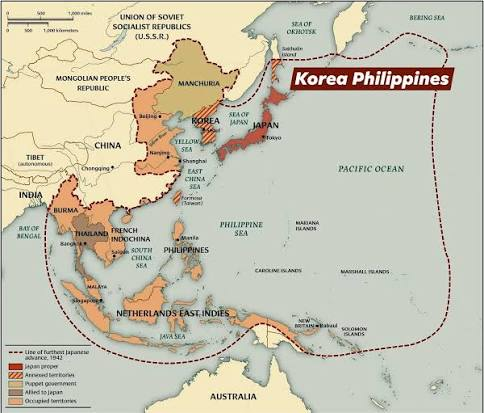
The entire military part of the Japanese plan was carried out 100%. But then, as often happens, its political part failed — the US simply refused to negotiate and kept fighting. As a result, Japan's "quick" war ended only 4 years later, in complete capitulation.
But what interests us more is how the Japanese managed to achieve such success with relatively small forces after 4 years of a losing war — when their army had degraded, and their economy was falling apart.
The Friction of Expeditionary War
So the key puzzle for us is: why, having shown terrible results in China against a weak opponent, was Japan able to inflict rapid defeat on what were then the world's strongest armies, using, at that, a grouping half the size?
Trying to compare army effectiveness in the abstract — carrying over an assessment of results from one conflict to another — is a basic mistake in military analysis. All wars are different, and first of all we must identify the specifics of each conflict, and only then can we carefully draw conclusions about carrying an army's experience over from one conflict to another.
The Specifics of the War in China
The war in China was, for Japan, an expeditionary one — it was fought by a separate army stationed on the mainland, whose logistics were carried out by sea. What was an "incident" for Japan was an existential struggle for survival for China. Expeditionary wars always create an asymmetry in the confrontation, due to a number of factors.
The first is the so-called "loss-of-strength gradient." The farther a state tries to project its military power from its own borders (or supply bases), the weaker that power becomes. A huge share of resources goes not into fighting but simply into delivering a soldier, a tank, or a shell over a great distance and sustaining them there. In an expeditionary war, for every rifleman there may be ten people in logistics. As a result, a hundred-thousand-strong army sent overseas may be able to field fewer rifles at the front than a local militia half its size.
Another factor is the "asymmetry of interests." An army for which the battlefield is "closer" has a host of implicit advantages — knowledge of the local context and terrain, resistance to local diseases, a strong network of informants, and so on. Moreover, such an army understands far better what it is fighting for — of course this mainly applies to the defending side, but even an occupier operating near its own borders will be better motivated than an army that has arrived from across an ocean. Motivation lets troops absorb greater losses, take riskier steps, and act with more initiative.
Even though China was initially a very weak opponent with an unstable political system, it fought literally for its survival, and did so desperately and inventively, both economically and militarily. When Shanghai and Nanjing (China's main industrial centers) fell at the end of 1937, the Chiang Kai-shek government made an unprecedented decision: to physically relocate the country's industry deep into the interior, to Sichuan province (to the new capital, Chongqing). Under fire from Japanese aviation, about 100,000 tons of heavy factory equipment (machine tools, presses, generators) were dismantled, loaded onto river steamers and junks. The relocated factories allowed China to set up its own production of rifles, cartridges, and grenades, making Chongqing practically invulnerable to Japanese ground forces (the Japanese were left only with bombing the city from the air).
The Chinese army adapted at the level of operational and tactical art as well. Chinese General Xue Yue (nicknamed the "God of War") developed a tactic to turn the Japanese advantage in mechanization against them during the battles for the city of Changsha. When the Japanese advanced, Chinese forces did not hold a rigid front line. They destroyed all the roads ahead of the Japanese, and themselves withdrew to the sides, letting the Japanese columns be drawn deep into their own territory. The Japanese columns were pulled in like a magnet into this "bag" that had formed. Their supply lines stretched incredibly thin, and their heavy artillery and tanks got bogged down in the mud. At that moment, Chinese divisions struck from the flanks and closed the ring behind them. Using "magnetic warfare," Xue Yue inflicted three devastating defeats on the Japanese at Changsha (in 1939, 1941, and 1942), destroying tens of thousands of Imperial Army soldiers.
At the strategic level, both Mao and Chiang Kai-shek concluded that a protracted war rather favored China, and that over time Japan would put itself in an increasingly disadvantageous situation. In his now-famous work "On Protracted War", Mao wrote:
The whole experience of the ten months of the war of resistance against Japan has confirmed the erroneousness of the two views discussed below, one being the theory of China's inevitable subjugation and the other the theory of China's quick victory. The former engenders a tendency towards compromise, the latter a tendency to underestimate the enemy.
Before the outbreak of the war of resistance, there was much talk of national subjugation, the argument running: "China is inferior to the enemy in arms and in national power in general, and hence is bound to lose in a war." After the outbreak of hostilities, the theory of national subjugation openly propounded by some persons collapsed, but the covert, and indeed quite influential, view still exists.
There have also emerged views symptomatic of the malady of impetuosity. Many people, for example, held an unwarranted optimism from the very beginning of the war. Some said, during the Battle of Shanghai, "Just hang on for three months and the international situation will certainly change, the Soviet Union will certainly send troops, and the war will be over."
These people pinned their hopes mainly on foreign aid. The first victory, at Pingxingguan, turned a few people's heads, and the next victory, at Taierhchwang, turned the heads of quite a few more. This raised doubts: would the enemy attack Wuhan? Many answered, "Hardly," or "Definitely not."
Yet the answer to this question is bound up with a whole series of major and important problems. Should we really pay attention to such matters as changing the system in the army, reforming the political apparatus, mobilizing the mass movement of the people, subordinating national education strictly to the needs of national defense, developing the war industries and improving the people's livelihood?
It even happens that when the military situation takes a favorable turn, some people become inclined to sharpen the friction between the Kuomintang and the Communist Party, thus shifting attention from external to internal problems. All this taken together,r we call political and military myopia. To the question, will China be subjugated? the answer is, no, she will not be, and final victory will be China's; while to the question, can China win quickly? the answer is, no, she cannot, and the war of resistance against Japan will be a protracted one."
Mao divided the war into three stages:
- 1. Strategic retreat: trading territory to exhaust the enemy, stretch his lines of communication, and weaken his economy: "In order to attain his goal, the enemy will have to bring into action at least fifty divisions, about 1,500,000 men, will have to spend one and a half to two years and disburse more than ten thousand million yen. Such a deep drive into our country will create extraordinary difficulties for the enemy, and the consequences are even hard to imagine"
- 2. Strategic stalemate: guerrilla warfare behind enemy lines. Japan controls only the cities and railways, while Chinese guerrillas control all the villages around them: "In the second stage the enemy will try to safeguard his occupied areas by, among other means, adopting the fraud of setting up puppet governments, and will strive to extend his area of occupation while plundering the Chinese people mercilessly. By this time China will still have a large regular army, but she will find it difficult to switch immediately to a strategic counter-offensive, partly because the enemy will have switched to the strategic defensive in the big cities and along the main lines of communication he has occupied, and partly because the Chinese army will not yet be fully equipped technically. The fighting in this stage will be ruthless, and the areas of military operations will suffer great devastation. As a result of the loss of big cities and difficulties in the war, there will be a certain amount of activity by wavering elements advocating compromise, and pessimism will grow to a serious extent. The international situation in this stage will become still more unfavourable for Japan, though there is no ruling out the possibility of some tricks reminiscent of Chamberlain's "realistic" adaptation to the so-called accomplished facts. Nevertheless, the chief international forces will give more help to China. Japan's threat to the South Seas and Siberia will increase, and a new war may even break out."
- 3. Strategic counter-offensive: when the enemy is exhausted, and the international situation changes: "It will also be necessary to rely on the help of international forces and on internal changes in the enemy country, for otherwise it will be impossible to win victory. The result will be that propaganda work abroad and China's diplomatic activities will assume greater importance. Weapons are an important factor in war, but not the decisive factor; it is people, not things, that are decisive. The contest of strength is not only a contest of military and economic power, but also a contest of human power and morale. Military and economic power is necessarily wielded by people. If the great majority of the Chinese people, of the Japanese people and of the people of the countries in the various parts of the world become opposed to the Japanese aggressors, can it be said that the military and economic power the handful of Japanese wield will remain superior? No, it will not remain so. If China perseveres in the war of resistance and in the united front, China's military and economic power will show a corresponding growth, while the enemy's military and economic power will assuredly decline as Japan continues to weaken because of the protracted war and because of her internal and external contradictions."
This kind of approach to strategy, too, can be considered one of China's many adaptations in fighting a stronger opponent. The Chinese managed to devise a whole range of adaptations, on every level — economic, logistical, strategic, and operational-tactical. Unlike the Japanese, the war was, for them, existential — all of this pushed them toward finding and applying the most unconventional solutions. They also understood the local terrain and context better, and relied on local support.
The Mirror Effect
If we now look at Japan's war against the US and Britain, the situation flips into the opposite direction. Yes, of course — the Japanese were the occupiers and aggressors, unlike the Chinese defending their own land. But for Britain and the US, Southeast Asia was even more remote in every sense — culturally, geographically, politically. For the Japanese army, this war was tied to 4 years of bloody fighting in China — it was precisely in victory over the US and Britain that they saw the way out of that war. Whereas for the US and British forces, this was just another set of distant colonies. It can be said that, despite the fact that Japan's war was not defensive, it was precisely the Allies who ran into all the difficulties of expeditionary war that the Japanese had run into in China. Let's go through the points:
Catastrophic underestimation of the enemy (cultural and racial arrogance)
The expeditionary forces (commanders in London and Washington) judged the Japanese through the lens of their own sense of superiority and did not understand the enemy's real military potential. It seemed to them that an Asian nation was incapable of challenging the white empires.
In John Dower's book War Without Mercy, it's noted that Western military analysts rated Japan extremely low:
"The Western countries badly underestimated Japan's intentions and capabilities. They rated the country, as one senior American military officer later summed it up, as 'nothing better than a class-C nation'"
American Colonel Bentley Mott expressed the contempt for Japanese innovation typical of the time:
"We have almost nothing to learn from Japan in the field of military technology or invention, and even less in strategy or the art of war... Japan is simply an imitator, and 'continues to follow in the wake of Western progress'"
Officers in Malaya reassured their soldiers with false claims about Japanese experience:
"Their own officers keep telling them: 'Don't worry about how well they performed in China — that was against a third-rate opponent like the Chinese'"
The "Tyranny of Distance" and the Logistical Nightmare
For an expeditionary army, remoteness from supply bases became an enormous problem. Moving soldiers, equipment, and aircraft took weeks and months, whereas Japan was operating much closer to its own bases.
The records note that Britain didn't even send modern aircraft to Malaya, believing outdated models would be good enough.
"There's a view, both in London and in Malaya... that 'well, Brewster Buffalo aircraft will do just fine here, let's keep the Spitfires in Britain.' It obviously became a real problem once the war began"
Right up until the war began, Winston Churchill considered sheer distance itself sufficient protection against the Japanese fleet:
"Consider how futile is the threat that Japan will send a fleet and army to conquer Singapore. It is as far from Japan as Southampton is from New York..."
Ignorance of the terrain and unpreparedness for jungle warfare
The expeditionary forces had been trained for classic European-style warfare and turned out to be utterly unprepared for the specifics of the tropics. They did not feel "at home" in the territory they were defending.
British command in Malaya built its tactics on a mistaken picture of the terrain:
"...the synergy and interplay of air, land, and naval forces allowed the Japanese to gain and exploit an advantage against an enemy defending in subtropical jungle, on terrain the British considered impassable"
Unlike the British, the Japanese made active use of unconventional methods, such as the "Bicycle Blitzkrieg" and light tanks, moving through the jungle. As historians note, the expeditionary forces felt like strangers on this land:
"One gets the sense this was an army, in December 1941, that was uncomfortable in the place it was defending, that felt utterly not at home there... I'm not sure the British, who had been in Malaya for decades, had much more of an advantage than the Japanese did"
Dispersal of forces (the need to defend everything)
Because the British and Americans were expeditionary forces, their infrastructure (especially airfields) was vulnerable, and they had to defend enormous territories with insufficient forces, which deprived them of any ability to maneuver.
The commander in Malaya, General Percival, tried to seal off the entire coastline at once:
"In response, he decided to try to defend the island's entire 80-mile coastline. The basis of the defense was that the enemy could not be allowed to land at all..."
The army was forced to guard airfields scattered across the whole territory:
"...the army had to disperse across the whole of Malaya (a country the size of England) in order to defend the airfields, so you ended up with a dispersed and overstretched army"
Colonial politics and weak civil-military cooperation
The expeditionary forces depended on the local colonial administration, which, until the very last moment, refused to put life on a war footing, afraid of undermining the empire's authority in the eyes of the local population and of disrupting the extraction of resources (rubber).
The records emphasize that the civilian authorities got in the way of the military building defenses:
"There were several reasons for the lack of effective civil-military cooperation. While pressure came from London to avoid disrupting critical rubber production... the main reason was prejudice and the policies of colonial rule..."
The civilian administration feared panic more than it feared the Japanese:
"...the colonial government's reluctance to do anything that might shake local confidence in British rule was a huge factor"
General Percival's reluctance to build field fortifications in Singapore is also well known, for the same reason: this was considered "bad for civilian morale" and might, for example, ruin the local golf club.
In many ways, none of these problems differed in substance, only in detail, from the problems Japan faced in China. This once again shows how foolish it is to draw conclusions about an army's effectiveness without analyzing the nature of the conflict it is engaged in.
One of the key concepts in military theory is "friction" — this concept captures the gap between planning and what actually happens in real combat because of a confluence of unexpected, individually small events occurring during a war, which break even the most brilliant plans. Expeditionary war increases friction and the complexity of planning exponentially. An opponent
located closer to the theater of operations gains numerous, sometimes small, advantages that together can add up to a decisive edge.
Back to the Present
Let's now try to assess the specifics of a possible conflict between Russia and the EU. Even a cursory glance is enough to see that for the EU this will be an expeditionary war, despite the fact that it will obviously be defensive. The main reason for this is that the primary countries under threat — the Baltic states and Poland — cannot defend themselves against Russia on their own, despite their rapid rearmament efforts over the past 4 years. They are part of NATO's overall defense system and will need support from the region's other key countries — Germany, France, Britain, and the Nordic countries. At present, all of these countries, to the extent they are present at all in a possible theater of operations, are present precisely as expeditionary forces — for example, Germany and Britain each have one brigade in the Baltic states, and are also represented in the air and air-defense components.
Of course, unlike the Philippines or Burma in 1941, the Baltic states and Poland are fully-fledged actors, and they will make an enormous contribution to their own defense. But even though the current situation has no colonial context, structurally the architecture of the EU's defense against Russia has a lot in common with what we saw in Southeast Asia in 1941. Let's go through the points:
Catastrophic underestimation of the enemy
Of course, we live in an enlightened age, and residents of Western countries won't make assumptions about Russians' combat qualities based on stupid physiological stereotypes. But among Western military figures and experts, we still see disregard for the experience of the Russo-Ukrainian war.
The most common trope goes like this — "the war in Ukraine is positional because of the weakness of the Ukrainian army, which cannot fight a war of maneuver; in a war with NATO, the war would be maneuverable":
However, given NATO doctrine's priority on air-land battle within multi-domain operations, and the military-political intentions of the Russian Federation, the likely character of a future war will be maneuver-based, at least in the initial stages of the conflict. In line with NATO's principles of "speed, surprise, force of action," offensive, fire, and maneuver capabilities, as well as C4ISR capabilities, will be key. In the event of a future war, artillery will once again inflict the greatest losses, at least during the maneuver phase. In the current character of hostilities, UAVs are playing the role of a substitute for artillery fire, an effect that is hard to replace — as conflicts of the 20th century have shown.
The Death of Maneuver? On the "Revolution" on the Battlefield in Ukraine
Many planners simply assume that NATO will easily achieve air superiority and that this will radically change the nature of the war against Russia. In many ways this echoes how the British believed the war against Japan would be won in the skies, through total air superiority.
The airmen assured everyone that they would be able to destroy up to 40% of the Japanese invasion force right at sea, before it ever reached the beaches. Army command built its plans on these promises. Commanding General Percival planned that his troops would only need to "finish off" the surviving remnants.
On top of that, the small army was forced to stretch its lines for hundreds of miles through the jungle simply to guard poorly located airfields against capture.
The bet on aviation alone turned into a catastrophe. When the Japanese landed, they smashed the small British air force within the very first days, destroying many aircraft right on the ground. Air superiority passed to Japan instantly and completely.
It's important to understand that air superiority truly is an extremely powerful tool. Complete air superiority means total control of what happens in the air over both your own and enemy territory — we can use any air assets over enemy territory, while the enemy can use none. This allows you to destroy the enemy's logistics, headquarters, and industry, including with manned aircraft, which can deliver amounts of explosives (many tons) that neither missiles nor drones can match.
How justified today is the expectation that the EU/NATO would seize air superiority in a war against Russia?
Let's start with the most fragile point — the only one who could even potentially do this is the US. No EU country has the capability — neither the aircraft nor the trained pilots — to conduct SEAD/DEAD operations (suppression/destruction of enemy air defenses) and seize air superiority. The probability that the EU could achieve this without the US is zero. We won't speculate here about whether the US would come to help — let's just note the fact that most of the relevant US capabilities are still in the Middle East.
Now let's consider just how difficult a task achieving full air superiority actually is in modern warfare. As an example, let's take the most recent case — the US war with Iran. A war in which the country most powerful at seizing air superiority faced one of the weakest countries in terms of air defense and aviation.
First, let's note that even if the US fully commits to helping Europe, the strength of an EU+US coalition would be far lower than the strength of the US coalition in the Middle East. The US operated alongside Israel — which is arguably the second most capable air-defense-suppression air force in the world. Moreover, the suppression of air defenses began with attacks on radars carried out by Israeli intelligence from inside Iran itself.
Another aspect is the strength of Arab-country air/missile defense — this is a region with one of the densest air-defense/missile-defense networks in the world. In the Gulf there is one long-range air-defense battery per 5,000–10,000 km² of area, whereas in Europe that figure is about one battery per 130,000 km² — an order-of-magnitude difference. A third of the world's total missile-defense capability (for intercepting ballistic missiles) is concentrated in the Gulf; Europe has practically none of that capability. In aviation we see parity — but of course European aviation is still more experienced. Air/missile defense matters for achieving air superiority not only because it simplifies protecting your own airspace, but also because it means aviation and air assets (AWACS aircraft, tankers) don't have to be diverted to defending your own airspace, and can instead concentrate on seizing the enemy's airspace.
On the other hand, comparing Iran and Russia shows they're in entirely different categories. While Russia has the largest fleet of aircraft in Europe and has 4++ generation aircraft, Iran has essentially no air force at all. While Russia has more than a hundred long-range air-defense batteries, Iran has only a handful. It mostly relies on simple, outdated copies of Western air-defense systems designed in the 1960s.
Even so, we can't say that seizing air superiority went smoothly even under these most-ideal conditions — a free-flight regime was not established over the entire country; the northeast was almost untouched, Iran shot down a large number of expensive MQ-9 Reaper drones and damaged several aircraft. This was predictable — it's an extremely difficult task.
It's enough to recall how Russia, at the start of its invasion, failed to achieve this over Ukraine, despite the technological, quantitative, and qualitative gap between Ukraine and Russia (which is far larger than the gap between Russia and NATO), and despite the fact that Ukraine's air-defense system was heavily damaged early in the war and let through a large number of missiles. But even so, every attempt by Russia to fly deep into Ukraine led to enormous losses for the Russian air force and the abandonment of that strategy.
But the most important thing is the fundamental shift in warfare brought about by the "democratization" of access to long-range strike capability. The war in Iran shows that full air superiority, in the form it used to be understood, is now hardly even possible at all. Despite complete air superiority over Iran, the US and all its allies were unable to protect their own airspace from Iranian drones and missiles. In effect, Iran managed not only to destroy tens of billions of dollars' worth of equipment at US airbases, but essentially made it impossible to keep using permanent US bases in the region — many officers ended up directing their forces from hotels and other places entirely unsuited for the purpose.
The American military believed that using air power over Iran would let it completely suppress the launch of any Iranian long-range weapons — but that didn't happen. An analysis of similar previous campaigns — from the Allies' hunt for V-2 launchers to American forces' hunt for SCUD missiles during the Iraq war — shows that suppressing mobile ground targets is extremely problematic for air power, for 3 reasons:
- Dispersal beats bombs: Destroying stationary factories and bases has value, but doesn't solve the problem of mobile forces. The enemy always adapts by dispersing his equipment along roads, into mountains, or into underground tunnels.
- Enormous drain on your own resources: Hunting for mobile targets diverts a huge share of your air power (from 15% to 40% of all sorties) away from other critically important strategic tasks.
- Chronically unreliable battle-damage assessment (BDA): From the air, it's practically impossible to tell a real mobile launcher apart from a good decoy or already-destroyed equipment. This leads to mass repeat strikes on "dummies" and false victory reports.
Square Peg in a Round Hole: AirPower against Mobile Targets and Missiles
To sum up:
- The probability of Europe achieving air superiority without the US is zero
- The probability of achieving air superiority over enemy territory with the US is fairly low, and shouldn't be relied on
- Even if it is achieved, this would not protect against Russia's response using its strongest capabilities — drones and missiles — and here NATO's preparedness on the eastern flank is extremely weak, incomparable to that same preparedness among the Gulf states
The belief that NATO will easily solve all its problems with Russia using aviation cannot be justified by anything except arrogance.
Analysts of the British General Staff wrote in 1940:
"Japan's successes are explained solely by China's complete lack of modern fighter aircraft... In a clash with the Royal Air Force, they would be swept from the sky on the very first day."
Today we see very similar arrogance from many NATO officials.
Many analysts share similar conclusions — for example, one of the best specialists on the Russian army, Michael Kofman:
NATO forces are not pursuing an increase in troop numbers that would allow them to hold a defensive line, nor are they engaged in the mass introduction of unmanned aerial vehicles and unmanned formations into their structure, which would allow them to achieve results comparable to those the Armed Forces of Ukraine are achieving. Perhaps they don't need to set aside their traditional advantages in air power and precision strikes, but it would be unwise to assume that nothing needs to change in order to counter the evolving Russian threat.
A Return to Mass: Russian Force Expansion in the War with Ukraine
The tyranny of distance and the logistical nightmare
The expeditionary character of the war means that French, German, or American brigades have to be moved east. Under current NATO standards, the alliance is supposed to be able to deploy 100,000 troops within 10 days, another 200,000 within 30 days, and up to half a million within 180 days. In addition, the Very High Readiness Joint Task Force (VJTF) is supposed to arrive on-site within 5–7 days.
Numerous analytical materials on the current state of NATO's logistics on the eastern flank show that this isn't realistic. The report "Roads to Readiness: Military Mobility Infrastructure on NATO's Eastern Flank" examines the weaknesses of NATO logistics at several levels:
- Sea ports. Germany is allocating €1.35 billion to reinforce the docks at Bremerhaven (North Sea) specifically so the port can handle the loading of heavy armor. But there are problems on the Baltic itself too. Although the Polish port of Świnoujście is equipped with special ramps for unloading tanks, the approach to it through the Świna Strait is an extremely vulnerable "single point of failure" — blocking the strait would shut down the whole port. Moreover, across the entire eastern flank there are only 15 military-grade ramps for unloading equipment from ferries, and their concentration in a handful of major ports risks creating enormous bottlenecks during any large-scale movement of forces.
- Railways. The eastern flank's rail network consists of both the European standard gauge (1435 mm) and the wide "Soviet" gauge (1520 mm) used in the Baltic states. Crossing between gauges requires transloading equipment or swapping bogies. At the Lithuanian-Polish border (the Kaunas–Białystok corridor), this causes delays of up to 24 hours for military cargo. Outdated infrastructure on secondary lines limits both speed and load capacity, with the average speed on these routes limited to 40–60 km/h for military cargo. In addition, many rail marshalling yards can't cope with a simultaneous large-scale movement of military cargo. The hub at Kaunas itself can handle only three military trains at a time, which is catastrophically inadequate for a mass movement of troops. Furthermore, only 30% of the available fleet of specialized rail cars is capable of carrying modern main battle tanks (such as the Abrams or Leopard). In Romania and Bulgaria, the shortage of super-heavy flatcars has been outright labeled a "critical capability gap."
- Roads. Although 68% of major highways meet NATO's military load standard (Military Load Classification 70), meaning they can bear heavy armor, the situation with secondary roads is dire. The average age of secondary road infrastructure is 27 years. Only 42% of secondary roads can bear military equipment weighing more than 60 tons. This is especially notable in the Podlaskie Voivodeship (eastern Poland) and Maramureș County (northern Romania), where rural roads often don't meet NATO standards. The most critical problem is bridges, which are the main "bottleneck" for convoy movement. 167 critically important bridges on the eastern flank have been identified as needing urgent reinforcement. Overall, 31% of bridges on secondary routes need either reinforcement or bypass routes built around them. In addition, European armies have an enormous shortage of heavy trailers for transporting tanks and other equipment. In total, the three main European military powers have roughly 300 military heavy trailers in service. Given the standard peacetime readiness rate for equipment (around 65–70%), in reality about 200 vehicles would actually be operational. That's barely enough to move a single heavy brigade by road at once. And NATO's plans for defending the eastern flank call for the deployment of dozens of brigades.
- Air infrastructure. Unlike the Cold War era, when NATO had hundreds of dispersed airbases, today the number of airfields capable of receiving heavy transport aircraft and modern fighters is limited. The small number of major airfields makes them predictable targets. If Russia delivers a massed strike on the key hubs, the aerial supply "bridge" would be instantly destroyed. Moreover, Europe has an enormous shortage of transport aircraft and, without the US, is simply unable to move heavy equipment by air at all. Nearly all aerial-refueling capability is likewise concentrated in the US. The last problem is aviation's dependence on large-scale fuel supply. Europe has no military underground pipelines, and all supply would depend on road logistics, which will already be overloaded.
- Outsourcing. In the 2000s, NATO armies decided to save money and outsourced military logistics to private companies. The most striking example is Britain. In 2001, the UK Ministry of Defence signed a PFI (Private Finance Initiative) contract with the company FASTtrax (a KBR consortium) to supply 92 Oshkosh tractor units. Under the terms of the contract, only 1/3 of the drivers are military reservists (Sponsored Reserves). Former commander of US Army Europe, General Ben Hodges, who has for years been sounding the alarm about the "Military Mobility" project, notes: "We rely heavily on commercial contractors to move equipment. But in a high-intensity conflict, civilian contracts and insurance stop functioning. You can't force a commercial driver from Germany or the Netherlands to drive into the range of Russian missiles near Suwałki if he doesn't want to. Logistics will grind to a halt at the edge of the danger zone."
Of course, during a war, all these logistical problems can be solved. But these problems will show up most acutely in the very first days and weeks of a clash. Broadly speaking, the troops currently in Poland and the Baltic states will most likely have to rely only on themselves in the initial clash.
Ignorance of the terrain and unpreparedness for the landscape of combat
Unlike the British and Americans, who operated in a jungle unfamiliar to them, Europeans will be operating in terrain typical of their own countries — fields and forests.
But it's important not to oversimplify the problems the British and Americans faced in the war with Japan by attributing them merely to the fact that they came from places without jungles. Most of the British troops were from Oceania or India — and of course their populations were quite familiar with jungle terrain. The problem was at the doctrinal level.
British doctrine was built around holding continuous defensive lines with a clearly defined front and rear, where the main task was to stop the enemy with heavy machine-gun fire and then destroy him with artillery. But the jungle sharply limited visibility, which negated the advantage in long-range firepower and created gaps between defensive positions. Japanese light infantry easily found these gaps, filtered through the jungle, and outflanked the British from the side or rear. The British, following doctrine, instead of fighting a war of maneuver, kept clinging to static positions until they found themselves surrounded.
British troops were heavily equipped and fully dependent on trucks for movement and supply. As a result, the army ended up rigidly "tied to the roads." Doctrine required protecting long, vulnerable lines of communication in the rear, which meant the British were constantly looking back over their shoulders. Meanwhile, the Japanese, traveling light, using bicycles and pack animals, could carry several days' worth of ammunition and provisions with them, which let them move freely right through the jungle and set ambushes on the British supply routes.
In the end, Western doctrine turned out not merely to be ineffective — it forced the Allies to fight the war on Japanese terms. The British army tried to force slow positional battles on an enemy who used light infantry, rapid infiltration, and constant pressure on the flanks.
We see a similar situation today. NATO strategists have traditionally viewed the forested terrain of eastern Poland as difficult for a rapid offensive. RAND experts, in their report "Reinforcing Deterrence on NATO's Eastern Flank," regularly point to the difficulty of the terrain:
The terrain in the region is characterized by a complex system of lakes, marshes, and dense forests that limit the movement of armored units outside the existing road network.
In many ways, NATO doctrine relies on a war of maneuver requiring large amounts of heavy equipment — and it's obvious that such a battle is practically impossible in an area of dense forest. That's why, for example, the part of the North European Plain has traditionally been considered the key axis requiring defense in Poland.
But what we're seeing in Ukraine right now completely upends this logic. Russian forces (and not only them) feel far more confident in forested terrain and built-up urban areas than on open plains. The drone revolution has radically changed the classic approach to assessing terrain. Like the Japanese in 1941, the Russians have adopted a tactic of deep infiltration. And for them this isn't something new or unusual — it's part of their military heritage.
In the memoirs of German General Friedrich von Mellenthin about the fighting of 1942, one can read:
"Almost every Russian offensive was preceded by the 'seeping through' of the front line by small units and individual fighters. In this type of warfare, the Russians had no equals... They would appear in the most unexpected places, places that were incredibly difficult to reach... Such infiltration was carried out with extraordinary skill, completely silently"
The infiltration tactic itself came from the actions of partisan groups. The Japanese borrowed it from the actions of Chinese partisan detachments. In the Russian tradition, this tactic has a deep connection to the actions of the Civil War, when deep raids and penetration behind the front line were used to destroy the enemy's rear and logistics. Later, this experience was generalized into the theory of deep operations by such Soviet theorists as Georgii Isserson.
In this theory, the enemy's army was viewed as an organism or structure, and destroying it required destroying its nervous system across a broad front — its communications, command, and logistics systems. All of this presupposed action deep within the enemy's formations. Later, these findings also formed the basis for NATO's modern AirLand Battle Doctrine.
Drones have largely changed the form in which deep operations are carried out, but not their essence. Russia uses its drone units to destroy logistics and command systems. Infantry, in turn, infiltrates through gaps in the defense in order to break the integrity of the front line.
Fortunately, Ukraine has developed an antidote to this approach — a combination of a kill zone in which the detect-to-kill chain happens extremely fast for the front line, and the use of drone-based air defense to cover the closer rear. At the same time, Ukraine itself actively uses a similar approach and has recently shown an even greater capacity to strike logistics.
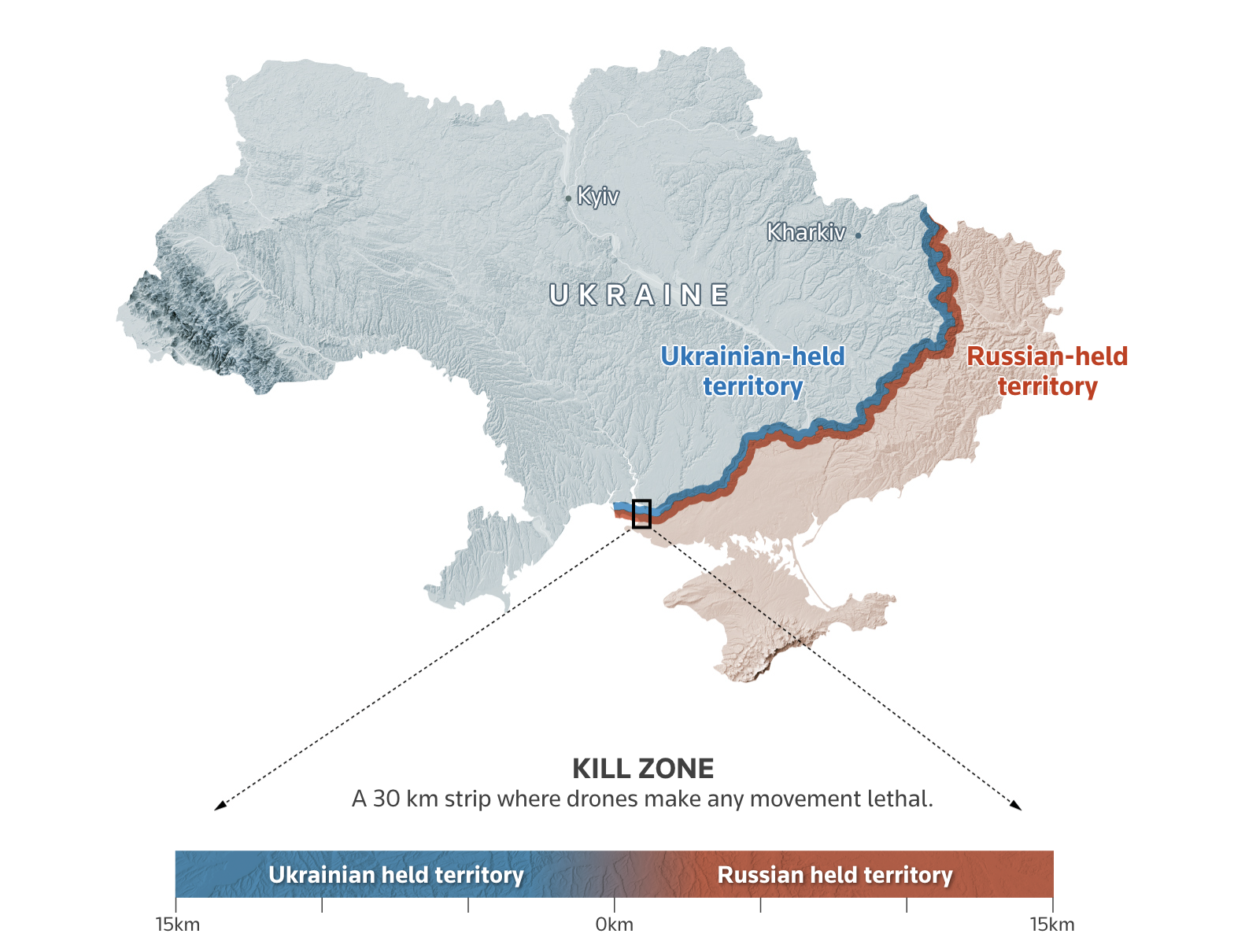
A kill zone, where drones and constant surveillance make movement practically impossible
It is precisely Ukraine's skill that causes the infiltration tactic to result in such slow advances by the Russian army (which have recently practically dropped to zero). But none of this — neither a system capable of establishing a kill zone, nor a system for covering against drones — exists in European armies. And meanwhile the terrain on the eastern flank is the most favorable possible for this kind of infiltration tactic.
Forests and built-up areas have become a natural shield for small groups:
"They prefer infiltration tactics in forested and urban areas, where there are more places to hide from drones, or where drones have more trouble orienting and attacking. To fool thermal imagers, these groups use thermal cloaks and move mainly at night."
How The Bear Bites – Anatomy Of A Russian Attack
The fact that in Ukraine this tactic leads to very slow advances says nothing about the tactic itself. No tactic will work once you've developed countermeasures against it. Infiltration doesn't mean slow movement. Just as the Japanese used bicycles to speed up the pace of their advance, the Russians use similar "light" mechanization tools:
"Motorcycles, electric scooters, civilian cars... and armored vehicles race at enormous speed through the gray zone. They often try to do this in bad weather, to reduce the effectiveness of Ukrainian drones"
How The Bear Bites – Anatomy Of A Russian Attack
In the war with Japan, British troops tied to roads, and a clear front line simply couldn't organize a defense against Japanese who were seeping through their positions. One British officer admitted:
"We couldn't fight off the main roads in the paddy fields. We didn't expect the Japanese to advance so fast through the rice paddies and rubber plantations. It was the speed that caught us off guard."
Today, NATO armies relying on mechanized formations are just as tied to roads. While NATO is preparing for a maneuverable, mechanized war, reality may turn out differently:
However, the operational conduct of such an invasion is likely to differ from the familiar armored breakthroughs that Western analysts often model. Drawing on lessons hard-learned in the Ukrainian theater, Russian command may forgo massive mechanized columns vulnerable to interdiction. Instead, a modern offensive is more likely to begin with ultra-intensive, synchronized cyberattacks and waves of missile and drone strikes on deep targets aimed at weakening air-defense assets. This would be followed not simply by bypassing large defensive formations in order to seize capitals, but by the penetration of dispersed, relatively small assault groups along several axes. These units will prioritize the rapid deployment and installation of sensor networks to create "kill zones," providing real-time reconnaissance and remote destruction of allied forces responding to the threat.
Undeclared War: How Russia is Attacking Europe
Modern analysts often tend to counterpose maneuver warfare based on the massed use of armor (the NATO approach) against an offensive based on infiltration (the Russian approach). In fact, these are two different approaches striving toward the same goal — destroying the enemy's army as a single organism or structure.
But whereas NATO's strategy could be compared to "dismembering" the enemy army's body, the infiltration-based approach is more like destroying the nervous system and severing the tendons. That is, at first glance, the enemy army's "body" is intact, but it is completely paralyzed.
This is achieved by localizing the area of combat operations and cutting off logistics with drone strikes, by breaking down the front-line defense with glide-bomb strikes, and by further infiltration through the enemy's combat formations, with logistics physically cut off as well. The fact that the infiltrating groups themselves are extremely weak and lack heavy weapons doesn't matter, because they themselves are not meant to storm heavy fortifications or fight heavy equipment. They will bypass any such threats, leaving them to drones or to heavy bombs and missiles. They themselves will operate against poorly defended lines of communication and accumulate in natural cover, establishing control points in the enemy's rear.
As we can see from the experience of the Japanese army, such a tactic can lead to rapid advances, not only to the positional standoff we see in Ukraine. Ukraine has managed to contain Russian infiltrations through its drone component and by bringing capabilities that used to be characteristic of the brigade/regiment level down to the platoon/squad level. This includes round-the-clock battlefield surveillance using Mavics and other cheap drones, as well as medium-range strike capability, which FPV drones have become.
Of course, what matters here isn't the drones themselves, but the fact that their adoption has become universal — practically any unit in the Armed Forces of Ukraine has some form of these capabilities one way or another. This gives units an extremely short "kill chain" — the chain for approving a strike decision. In effect, such a decision can be made at the very lowest level, unlike with traditional strike assets such as aviation or artillery.
For marketing purposes, this strategy was named the "Drone Line," and it has sharply increased Russian losses during infiltration and slowed their rate of advance. After Western analysts sounded the alarm and the 2025–2026 wargames (for example, from the RUSI and IISS institutes) showed a shift from a clear front line to a "diffusion" model, European states began trying to adapt.
The EU announced a "Drone Wall" program, which then splintered into separate national projects. Poland has gone furthest of all. It has already begun physically building fortifications under the "Eastern Shield" program on the border with Russia's Kaliningrad region and with Belarus. Since mere physical barriers won't stop small groups of saboteurs, this project is a multi-layered "intelligent border," in which drones and surveillance systems play the key role: a "Digital Vision" (AI surveillance) layer is meant to detect infiltration groups, while autonomous "dronenests" are meant to launch drones that will destroy the enemy.
At first glance, this looks a lot like the Ukrainian approach of a continuous detect-and-destroy cycle. But whereas in Ukraine such capabilities are tied to army units, the EU countries want to build this kind of system, so to speak, outside the army, tying it to fortifications on the border. This is being done to avoid the complicated process of reforming the army and instead solve the problem technologically, by creating a superweapon that will fix everything. But in this form, these capabilities simply lose all meaning and become even less useful than plain minefields. As analyst Maximilian Dura correctly points out, the Russians will simply be able to destroy this line before the offensive even starts:
Knowing about the existence of the anti-drone barrier, the Russians will undoubtedly deploy something that will destroy it effectively and cheaply. And then the European anti-drone wall, built with such effort, will come crashing down.
Unijny mur antydronowy to fikcja
The Russo-Ukrainian war has shown that any static line of defense can only serve as an auxiliary system for units that possess flexible capabilities for detecting and destroying the enemy at ranges of up to 30 km on their own. Rigid attachment to fixed defensive structures will only make it easier to infiltrate your rear and rout your flanks and rear.
Here's how it looked through the eyes of Allied troops during the war with the Japanese:
The commander of the 11th Division, General Murray-Lyon, was struck by the Japanese's maniacal tendency "to go around any flank across any terrain." Brigadier Massy-Beresford, observing the hopelessness of trying to build a stable front line, remarked in despair: "I couldn't shake the feeling that this forested terrain, with no prepared positions and a limited number of troops, could not be defended, especially in the face of the enemy's skillful infiltration tactics." American military observers noted in their reports that Japanese soldiers moved on bicycles in groups of 60–70 men, "moving at a speed of 8–10 miles per hour [about 13–16 km/h] and carrying 70–80 pounds [about 31–36 kg] of equipment." "The British couldn't get away from the troops on bicycles. They were caught, driven off the paved roads into the jungle, and forced to surrender. The constant pressure and merciless pursuit had a psychologically devastating effect on the defenders"
All of this was achieved using nothing but bicycles and a hand-held 50mm mortar. Today, using heavy drones, such infiltration groups can be supplied with heavy weapons, ammunition, anti-tank weapons, and round-the-clock air support from strike drones. This is already happening on the Ukrainian side — and Russia will inevitably adapt and adopt this tactic too. Here's how Russian pro-war z-channels describe it:
Thanks to the capabilities of Ukraine's aerial logistics, there has been a natural evolution of assault tactics. Personnel go through the kill zone light. Meanwhile, their resupply happens by air. Let me explain. This isn't a shabby little strongpoint where food and medicine get tossed in. This is a fresh assault group that gets dropped body armor, ammo, "birds" [drones], HEAVY WEAPONS, Starlinks, and so on, by a "Baba Yaga" (heavy drone). Once they have everything they need, the fighters make their dash. And it's an effective dash, because they didn't have to lug dozens of kilos of gear on their backs for tens of kilometers. A natural transformation of logistics has taken place — it hasn't disappeared; it's gone airborne. Isolated actions have grown into a supply system. The enemy's dominance in the sky hasn't just made our logistics harder — now our assault troops can unexpectedly run into a heavy machine gun or a well-equipped group with anti-tank weapons in places where, before, there used to sit only exhausted fighters with a rifle and minimal ammo.
As historical experience shows, units most often lose the ability to defend themselves not because of exhaustion, and not even because of logistical constraints — the most terrifying thing in war is surprise, and the enemy's ability to appear where he isn't expected. Marc Bloch, in his book about the Germans' defeat of France in 1940, writes:
I have seen men who had gone into the line the day before under murderous fire without turning a hair, running like rabbits merely because three shells fell, quite harmlessly, on the road where they had piled their arms in order to get water. Time and again during May and June I heard the remark: "We've been sold." Bloch explains this shift in behavior as follows: the Germans turned up where we did not expect them, and in places we had never been told to expect them. There were, in consequence, certain breakdowns which cannot, I fear, be denied, and which occurred mainly because our men had been trained to use their brains too slowly. Our soldiers were defeated, and, to some extent, allowed themselves to be too easily defeated, mainly because their minds worked too sluggishly
Strange defeat. What we can learn from those who lost
Just as today, military leaders were deceived by observing the enemy's tactics, rationalizing them without changing their own approach:
Marc Bloch explains that the French were well aware of German tactics. Like us today, they watched the Germans seize the Sudetenland, part of Czechoslovakia. They watched the Germans, with Soviet help, invade Poland, using new tactics and weapons. The Allies could have anticipated this tactic and the speed of the German army, had they been paying attention and, most importantly, had they been willing to listen. Bloch describes how the culture and attitude of the French high command simply ignored these observations. The information was there, but the readiness to adapt was not. "Our leaders, or those who acted in their name, were incapable of thinking in terms of the new war. In other words, the German triumph was, essentially, a triumph of intellect, and this is what makes it so especially serious."
Strange defeat. What we can learn from those who lost
A failure to understand the changes in warfare and an unwillingness to adapt to the enemy's tactics leads to even one's own country's landscape being understood incorrectly. Forests that help the enemy infiltrate come to be seen as protective barriers, while static defensive lines — vulnerable to infiltration and restricting the maneuver of one's own troops — come to be seen as the foundation of defense.
Dispersal of forces (the need to defend everything)
Today, the situation with the dispersal of forces is just as difficult as it was in 1941 in Southeast Asia. Along more than 2,000 km of border, the expeditionary forces of Britain, the US, Canada, and Germany are represented by only 22,000 personnel.
At the same time, whereas NATO previously assessed its capabilities sensibly, and assumed these troops would be used as a "signal" to Russia and as a way to slightly delay the advance of Russian forces in the event of an attack — but not to prevent the occupation of NATO countries entirely — now, after the discovery of mass killings of civilians in the occupied territories of Ukraine, the decision has been made to "defend every square centimeter of NATO territory." The concept of Deterrence by Punishment has given way to a strategy of Deterrence by Denial.
Under these conditions, these fairly small forces will be stretched thin, just like the British forces in Malaya, which tried to cover the entire coastline and deny the enemy even the possibility of landing — which produced the opposite effect. The dispersal of forces helped the Japanese use infiltration and smash these forces piecemeal:
In the end, the British attempt to defend "everything at once" meant they ended up defending nothing. Japanese forces covered the peninsula's 700 miles in a record 70 days, keeping the stretched-thin and disoriented British army in a state of panicked retreat the whole way
Bicycle Blitzkrieg: The Malaya Campaign and the Fall of Singapore
Today's situation differs for the better from the situation 70 years ago. Whereas back then Southeast Asia was a subject-less vassal region, today the Baltic states and Poland are independent actors with full agency, capable of taking responsibility for their own defense. Can Poland and the Baltic states make up for the gaps created by the weakness of allied units?
On paper, over the last 4 years Poland has invested billions in rearmament, and over the coming decade Poland plans to spend more than $90–100 billion on modernizing its army and buying equipment. Poland plans to field armed forces totaling up to 500,000 people by 2030. Of these, 300,000 will be regular contract troops, and 200,000 will be territorial-defense forces and active reserve (currently the total stands at around 200,000). This army is also expected to field more than 1,100 modern tanks, which exceeds the combined armored fleets of Britain, Germany, France, and Italy.
But an army is not a collection of tanks and people — first and foremost,t it's combat-ready units. You can have thousands of tanks, but if they're not organized into units with the necessary logistical and other support, they won't be able to take part in combat operations.
Poland currently theoretically has six land divisions. However, in the event of a war with Russia, only two of them would be able to enter combat from the very first hours: the 16th and 18th Mechanized Divisions (the so-called first-line, or first-echelon, divisions). But even they have not yet finished forming all their new units. Two entirely new divisions are currently being formed (the 1st Legions' Infantry Division and the 8th Home Army Infantry Division). That's the situation on the country's eastern borders. The other two long-established divisions, which are not considered first-line divisions (the so-called second echelon), are the western divisions: the 11th and the 12th. They are only partially manned, meaning their units would need to be fully manned before entering combat. As a result, most of their units would not be able to take part in combat operations on the first day of a war. That could take anywhere from ten to 30 days.
Tylko dwie z sześciu polskich dywizji gotowe od razu do walki
The Polish standard for a mechanized/armored division, close to the American one, calls for a size of 18,000–22,000 personnel and 200–300 tanks. That means the total available troop strength doesn't exceed 50,000 people.
The Baltic states together can field 3 divisions — which are of course much lighter, smaller, and have almost no heavy equipment. But even they are not fully combat-ready — Lithuania's 1st Division won't become fully combat-ready ("operational") until 2030. Internal audits and independent defense reports show that, despite high weapons-procurement budgets (Estonia and Latvia are spending a record 5.4% and 4.9% of GDP, respectively), these countries acutely lack supply infrastructure. Active construction of dispersed underground ammunition depots only began in 2026. At the same time, the Baltic states have practically no ground-based air defense, which also limits their capabilities.
In other words, globally, on a front line fully comparable in length to the Russia-Ukraine one, we have 5 understrength divisions, totaling fewer than 100,000 people (even counting all the allied forces together). Moreover, these forces are not nearly as integrated as Ukrainian units are, since they belong to different countries. And despite so-called NATO standards, we still have problems with poor interoperability of equipment and approaches between different armies.
In addition, they are located in two separate zones — Poland and the Baltic states, connected by the 8-kilometer-wide Suwałki Corridor, which would be quickly cut off in the event of war. Moreover, supplying the Baltic grouping without capturing the Kaliningrad region would most likely be impossible, since anti-ship missiles and air-defense missiles based there could control the air and sea routes. Ukraine, even without modern anti-ship missiles, managed to create an access-denial zone in the Black Sea using naval drones — Russia's capabilities here are far greater.
But perhaps there are upsides to this kind of dispersal of limited forces? The development of drone warfare requires greater dispersal of forces, because of the increased transparency of the battlefield and the lethality of long-range strikes. But here too we see the opposite situation. The limited forces are not dispersed along the border but concentrated at a handful of points, many of which sit right up against the Russian border.
All of Poland's heavy equipment is concentrated at literally a few large tank bases. Some of them (for example, the Polish bases with K2 tanks and K9 howitzers at Braniewo or Węgorzewo) are just 10–20 km from the Russian border. The high speed of rearmament meant that infrastructure couldn't keep up with the pace of equipment purchases. In the event of a surprise attack, it's highly likely that these bases would simply be destroyed by heavy glide bombs, with any exit routes from them placed under fire control by strike drones.
The situation with the air component is no better — almost all fighter aviation is concentrated at 2 airbases, in Poznań and Łask. Both are within range of Iskander missiles. Moreover, Ukraine's operation "Spiderweb" showed just how vulnerable such giant superbases are.
Given all this, it becomes clear why, until [20]22, the doctrine of the "Tripwire" force was adopted, under which the purpose of the troops on the eastern flank was only to signal a readiness to fight and, if necessary, to engage in combat while retreating, tying down the enemy and buying time to move forces in from Western Europe. From the standpoint of military expediency, this was logical. This doctrine made it possible to preserve equipment and personnel, to maneuver, to draw the enemy deep into the territory, to stretch out his logistics, and to destroy him in a counteroffensive. It matched the realities on the ground — the forces and assets actually available.
This came through most clearly with the publication, by Poland's PiS government, of the 2011 defense plans, which allowed for the possibility of maneuver and retreat if necessary. PiS's slogans claiming that the previous government had wanted to "surrender Polish lands up to the Vistula" were loud, but the reality was far more complex:
In the end, these plans weren't the brainchild of Tusk or his defense minister Bogdan Klich — even though he did approve them — but were developed by General Staff officers. They are backed by the authority, knowledge, and experience of the Polish army as an institution. The fact that Minister Błaszczak is now turning a plan of this scale into a campaign poster is genuinely regrettable.
But there's a second reason I'm in shock. This plan wasn't the result of decisions Tusk or Klich made simply because they felt like it. It was based on the defensive capabilities of the Polish army, its equipment, its numbers, the combat effectiveness of its units, and the presence of allied forces on our territory.
Have these figures changed substantially over the past twelve years? In my view, not by much. The equipment purchases initiated by the Law and Justice party (PiS), and the redeployment of some units further east, have not yet produced any qualitative change.
So I, unfortunately, worry that the current plan may turn out to resemble the 2011 plan. That makes Minister Błaszczak's actions even more irresponsible.
Prezentujemy się światu jako państwo po prostu głupie
Weak civil-military cooperation
The British in 1941 suffered greatly from the actions of a colonial administration that didn't want militarization of the region, since it contradicted its civilian goals. Today we have no colonies, and Poland and the Baltic states are independent democratic states. But this doesn't remove the problem of conflicting military and civilian goals.
The shift to the concept of defending every centimeter of NATO territory was driven by purely political considerations and was not coordinated with military objectives. Anyone even slightly familiar with military history knows that you cannot organize a defense right at the border itself. Any defensive line requires "depth." In front of the defensive line, you need a fairly wide security zone (20–30 km), followed by defensive lines spaced apart from one another. All of this is needed in order to identify the enemy's axes of attack, to be able to fall back to additional lines if necessary, and so on. In addition, it's necessary to ensure separation between the different defensive lines — from the notional zero line to safer second and third lines further back, which can devote more attention to sustaining logistics and responding to breakthroughs.
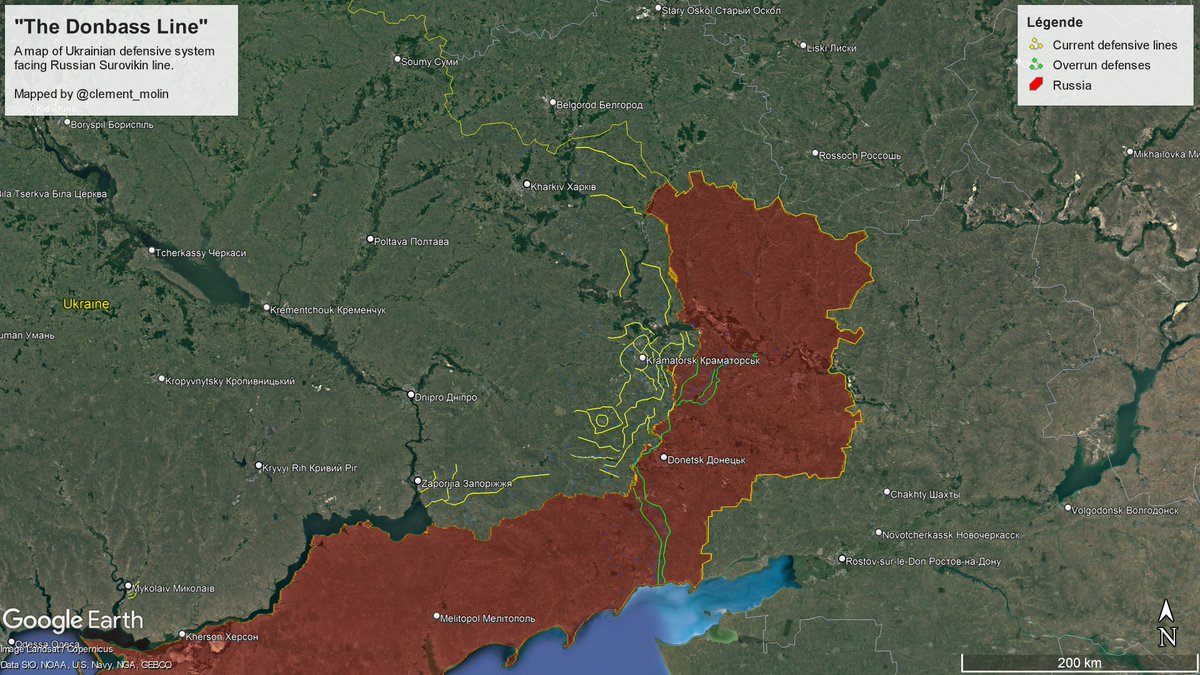
An example of what Ukraine's defensive lines in the Donbas look like
But after residents of Western countries learned what Russian occupation looks like from reports out of Ukraine, the requirements placed on the military changed. Defense right at the border exposes troops directly to artillery and drone strikes, and deprives the army of depth and room for maneuver.
Of course, it is necessary to have some militarized forces right at the border to minimize provocations and to signal that any military action will be met with a response, and that a "hybrid attack" would become impossible, since it would immediately provoke a response:
Perhaps even more important, states that have a resistance capability are not vulnerable to a fait accompli. If Russian troops cross the Estonian or Polish border, shooting will start, regardless of whether the Russians claim their forces are separatists or "little green men." Once shooting starts, there's no more talk of "hybrid war." It's simply an ordinary war, and ordinary decisions about involvement apply
This is exactly what happened in the Donbas in [20]14, when Ukraine began putting up resistance to Russian-backed militants, and an attempted hybrid invasion, as in Crimea, immediately
turned into a real war. That's exactly why talk of a "hybrid threat" is more of a distraction. And it's solved with a simple strengthening of the border component and rapid-reaction forces.
But if we're facing full-scale combat operations, trying to hold the border with everything you've got is ruinous for even the strongest units. At best they'll be surrounded and able to temporarily delay the enemy's main forces; at worst they'll be destroyed in the course of a disorganized retreat. In NATO's political and military planning, this problem is called the "conflict between forward presence and defense in depth."
Thus a good defense is a "deep," multi-layered system of fortifications and a large, distributed military infrastructure — dispersed bases and depots that are easy to camouflage and hard to destroy all at once, and a large number of pre-prepared positions for air defense and artillery. But in a democratic state, an attempt to build such infrastructure runs into a host of problems. Building any infrastructure at all in democratic countries runs into problems because of NIMBYism — people who oppose construction of anything near them — and the many stages of approval required from municipal and regional authorities.
Now imagine you have to build defensive lines dozens of kilometers deep, across the entire country, and in theory these need to be built at some distance from the border. A huge share of the territory where anti-tank ditches, bunkers, minefields, and gun emplacements need to go is someone's private property. In a democratic state governed by the rule of law, the government cannot simply take land from its owners without lengthy legal procedures, valuation, and compensation payments. Local residents of border regions are actively opposing the seizure of their land. Fears of losing a business or a family farm turn into lawsuits, which freeze work on specific parcels for months.
Because of the reluctance to get into tough court battles with farmers, the military has had to look for workarounds. As Poland's chief of engineering troops explained in an interview with Defence24, the army has been forced to negotiate with the National Support Center for Agriculture (KOWR) and with private landowners.
Since it's impossible to carve out land for anti-tank ditches exactly along the boundaries of private plots, the military has to fragment farmers' land holdings. Instead of full confiscation of land, a "multi-year loan/lease" scheme is now being introduced, with regular financial compensation paid to farmers for the fact that they can't use their fields. All these negotiations and cadastral subdivisions of plots require a gigantic amount of paperwork and approvals, which greatly slows down the actual progress of construction equipment on the ground.
Indeed, the pace of fortification-building speaks for itself — over the past six months Poland has built 1 (one) kilometer of fortifications. More radical and rapid measures are practically impossible without involving society in defense planning. Back in [20]22, Poland's Razem party warned about exactly this:
In the non-military sphere, the thoughtlessness of successive governments has been even more pronounced. Cutting spending and slashing social investment has dominated thinking on key state matters. This has led to a dramatic neglect of the security of Poland and its citizens. Special note should be made of the removal of civil defense from the Polish legal system with the adoption of the Homeland Defense Act. Meanwhile, defense is not only about the integrity of borders, but also about the protection of human life. Indeed, it must be acknowledged that protecting the life and health of the civilian population is not only an integral part of defense, but, to a certain extent, its highest criterion. The army cannot carry out its mission without a strong, organized society standing behind it. That society is also the basis for restoring its combat capability.
Stanowisko Razem ws. obronności
This kind of estrangement between the army and society leads to even a normal, adult conversation about the need to prepare for defense being received with extreme nervousness. Just as the British civilian administration in Southeast Asia feared panic more than it feared the Japanese, politicians in the Baltic states and Eastern Europe react extremely nervously to alarmist articles by Western analysts about a possible war, fearing capital flight and panic among the population.
They can be understood — panic causes enormous damage to society and the economy. In fact, the mere presence of panic in Western societies would already be a huge victory for Russia. But fear of panic, and the absence of serious discussion of the risks, is also a problem. This kind of neuroticism around the defense question is simply a consequence of just how far politicians and the military have drifted from society as a whole. People start to perceive the defense question as binary — either Russia will attack tomorrow, meaning we need to run for it right now, or it won't attack, in which case there's no point taking decisive preparatory measures at all.
All of this comes from weak public engagement with defense issues. The one bright spot here is the territorial-defense system (TDF). Poland's WOT (Wojska Obrony Terytorialnej) is the largest and fastest-growing territorial-defense project in the region. The structure's headcount has already exceeded 44,000 people (of which about 37,500 are active volunteer reservists). Notably, more than 21% of WOT personnel are women — one of the highest figures in NATO.
The Polish TDF has also launched large-scale civilian training programs. In just its most recent courses, tens of thousands of people have been trained in basic survival skills, tactical medicine, and cyber hygiene (the plan for 2026 is to train about 70,000 civilians). Beyond that, they have been actively used to guard the border with Belarus during migration crises and to deal with the aftermath of floods, proving their usefulness in emergency situations.
Preparing for the Last War
Ordinarily, the fact that Russia is stuck in a long, troubled war that is clearly not going according to a winning script is viewed by European leadership as a pure minus for Russia. Russia is simply burning through resources that it could otherwise use to threaten Europe militarily, so as long as the war continues, Europe is safer.
In Russia, this is largely perceived differently. Back at the very start of the war, when the failure of the Russian army became obvious, insiders said that Putin remarked: "It's good that our weakness was exposed now, rather than during a clash with a serious opponent — we'll gain valuable experience."
Of course, in many ways this is an attempt to give some kind of meaning to an obviously meaningless war. But there is a grain of truth in it too — a fighting army inevitably learns. The Russian army mostly learns from its own mistakes, but we still cannot afford to underestimate this process.
Lessons From China
British and American analysts also saw how the "Chinese quagmire" was weakening the Japanese army. But they failed to understand that one needs to look not at how the enemy army is fighting right now (because this style of warfare may be necessary because of previous mistakes), but try to predict how it will fight once it recognizes the mistakes it has made.
What lessons did Japan draw from its failed war in China?
Maximum concentration of forces and means in the first phase of the war
The invasion of China was initially planned as a small, quick operation with limited forces — in large part this was the initiative of individual generals, not a nationwide war from the very start. Because of this, after the fast offensive failed, the war began demanding more and more resources. But as we've
already said, stretching the use of resources out over time in war means they simply "burn up," and their effect never adds up to an overall result. This led to Japan getting bogged down in the war and gave China the opportunity to trade territory for time.
Preparation for the 1941 war was already carried out with an understanding of the importance of timing in planning military operations. Japanese command (in particular, the 25th Army's operational planner Tsuji Masanobu and General Tomoyuki Yamashita) understood that any campaign against the Western powers had to be won before they could move up reserves. In Malaya, they applied a tactic of aggressive advance, never giving the British a chance to dig in. The Malaya campaign and the capture of Singapore took only 70 days — a month ahead of schedule:
This was the whole concept behind Yamashita: we had to keep the British constantly retreating, keep them off balance, and just drive them down [the peninsula], because we had no logistics for a long war. If the British managed to get a lot of reinforcements to Singapore, we were finished. So he intended to start the invasion as early as possible, simply to preserve this offensive momentum. This tight schedule for the first phase had certain tactical advantages, such as reducing the Allies' chances of bringing up reinforcements by denying them their forward bases, or confronting the Allies with a stunning fait accompli
The same can be said of the Russian army. If you read the reflections of Russian pro-war bloggers, you'll see how they constantly lament the fact that the Russo-Ukrainian war began as a limited "special operation" rather than starting right away with the use of all forces and means under full mobilization.
One of the main problems for the Russian army in the first phase of the war was that the Russian army had been structurally built and reformed on the assumption that waging a large-scale war would require calling up reservists. But Russia's political leadership launched the full-scale invasion using peacetime forces, in order to avoid political costs, which led to a critical shortage of manpower, understaffed units, and an inability to hold overstretched front lines.
Underestimating logistics
Not thinking about a long war in 1937, the Japanese army also gave no thought at all to the question of logistics. The army was heavily dependent on roads, which retreating Chinese forces destroyed, and on pack animals:
The Chinese armies destroyed every road and route that could be used by Japanese mechanized equipment
Battle Hymn of China, Agnes Smedley
In 1940 the Imperial Guard and the 5th Division were converted from pack horses to full motorization. The 18th Division remained on the old establishment, still heavily reliant on pack horses. This complicated Yamashita's logistical problems...
The Defence and Fall of Singapore, Brian Farrell
In response to these difficulties, the campaign against the Allies was planned from the outset with logistical complications in mind. The solution was found in using bicycles as a cheap means of individual "mechanization." This allowed movement to be silent, freed the force from dependence on scarce fuel, let soldiers carry more supplies on their own, and made it easy to bypass traffic jams. In addition, remembering the wrecked communications in China, the Japanese attached a colossal number of engineering regiments to the advancing divisions, which restored more than 200 bridges blown up by the British with incredible speed.
The 25th Army had a number of independent engineer regiments, because they knew that during this campaign they would have to rebuild an enormous number of bridges... so credit is due to Tsuji for handing Yamashita the ideal tool for a 600-mile overland march
Percival and Yamashita - Malaya and Singapore 1942
We see a similar shift in logistics approach in the Russian army too — the use of individual means such as motorcycles and scooters, combined with drone and ground-robot logistics, allows small units to operate at a considerable remove from their main support.
Betting on flank infiltration
During the battles for Shanghai (1937), Japanese command tried to break Chinese resistance through direct infantry pressure, which led to enormous losses and a positional stalemate.
Sacrificing his advantage in artillery, Matsui resorted to massing infantry in narrow sectors — around 60,000 men on a front only 6–8 miles wide — to break the defenders through a crude frontal assault... The combination of natural obstacles and fortifications turned the Japanese advance into a meat grinder. Over the course of October, the Japanese lost around 25,000 men in attacks on prepared Chinese positions
The Battle for China: Essays on the Military History of the Sino-Japanese War, Mark Peattie, Tower of Skulls, Richard B. Frank.
When, in December 1941, the Japanese ran into British roadblocks on the roads of Malaya, they categorically refused frontal breakthroughs. The standard playbook became the so-called "J" maneuver (infantry going around through the jungle into the rear) or a seaborne landing by light boats behind the defenders.
The standard Japanese pattern of envelopment during the campaign was to pin the enemy with a frontal blow from one-third of a division's infantry strength, while the other two-thirds carried out a flanking march into the enemy's rear. This tactic, known as the "J" maneuver or "J-tactic," succeeded again and again.
Bicycle Blitzkrieg: The Malayan Campaign and the Fall of Singapore (US Army Command and General Staff College / Tsuji Masanobu).
Every time they ran into a British defensive position, they either smashed through it with tanks or carried out a double envelopment through the jungle — a short "hook" and a deep "hook." You understand that they had decided to fight for the roads by leaving those very roads... they treated the land and the jungle almost like open ocean"
Misfire: British Empire Special Forces and Defeat in Malaya in World War II, Brian P. Farrell
Russia has also, from its own experience, come to realize the problems of frontal attacks. The losses it's suffering only keep increasing every year. Even though [20]22 was perceived in the media as a total failure of a year, and the following years as a recovery of Russian potential, in fact it's rather the opposite — the results-to-losses ratio in [20]22 was far more favorable for Russia than in any of the following years.
Russia didn't shift to frontal attacks combined with infiltration out of some good position — it was rather a way out under conditions of an already established, dense, fully surveilled front line. Many analysts, including Michael Kofman, see weakness in this — a loss of the ability to conduct maneuver operations.
As Russia's numerical superiority grew, its ability to apply force at scale declined. This produced a paradoxical dynamic: as Moscow built up its forces, the value of that mass steadily diminished. The quality the Russians were counting on achieving through numerical superiority failed to materialize on the battlefield, but was, over time, offset by Ukraine's adaptation, its technology, and Western capital. The expansion of Russian forces created an opportunity for battlefield successes, but this advantage proved indecisive, ultimately yielding diminishing returns.
A Return to Mass: Russian Force Expansion in the War with Ukraine
But, as Kofman correctly notes, in large part the inability to conduct maneuver is a consequence of adaptation on the Ukrainian side. Ukraine, too, is unable to conduct maneuver operations most of the time, but when a window of opportunity opens for them — as happened in the Kharkiv or Kursk operations — Ukraine has been quite successful in exploiting it. It would be strange to think Russia couldn't do the same.
In turn, the border with Poland and the Baltic states presents ideal conditions for such operations — an extremely low concentration of troops and a weak surveillance-and-strike network, combined with dense forests convenient for infiltration and flanking operations.
Strengthening the reconnaissance-strike complex
At the start of the China campaign, the Japanese had serious coordination problems: infantry often advanced without heavy artillery (which got stuck in the mud), and the army and navy clashed sharply with one another. Aviation was taking losses and coordinating poorly with ground forces.
The lack of fire support was one of the main causes of Japanese failures in the early stages. So they approached the [19]41 campaign very differently. General Tomoyuki Yamashita, commander of the 25th Army in Malaya, understood perfectly well that towing heavy artillery along the few narrow roads and through rubber plantations would be too slow. Having served as military attaché in Germany, he had studied the Blitzkrieg tactics of the Luftwaffe and the Wehrmacht. He decided to hand the functions of heavy artillery over to tactical aviation, which could move at the speed of infantry advancing on bicycles and the light tanks accompanying them.
A crushing blow was delivered on December 10, when the Japanese sent bombers that sank the British battleship Prince of Wales and the battlecruiser Repulse... this deprived Malaya of the only naval protection it had
Bicycle Blitzkrieg: Japan's Race Down Malaya
After they destroyed Force Z off the coast of Malaya, they dominated the sea and could land anywhere on the Malayan coast of their choosing, and they dominated the air after, within the first three days, sweeping the Royal Air Force in the Far East from the skies over northern Malaya and forcing it to retreat to Singapore
Misfire: British Empire Special Forces and Defeat in Malaya in World War II, Brian P. Farrell
The infantry were also armed with light 50mm mortars capable of striking lightly defended targets at ranges of up to 700 m. This solved several problems at once. First, it let units moving through broken terrain add firepower: when the British expected a frontal attack down the road, they would suddenly be hit by a hail of high-explosive mortar bombs from the "impassable" jungle on their flanks and rear. To the defenders, it looked as though Japanese artillery was materializing out of thin air.
Second, it decentralized firepower. In Western armies, mortars were more often concentrated at the company or battalion level. The Japanese, by contrast, had 3–4 light mortars in every infantry platoon. That meant a Japanese sergeant didn't need to radio the rear and request an artillery strike on a machine-gun nest — he could give his subordinate a direct order.
Japan demonstrated an excellent example of how changing the coordination between strike assets and advancing troops can produce a breakthrough result.
The story of the Russian army's adaptation is, in many ways, similar. At the start of the invasion, Russia had enormous firepower, but the organization of strike coordination was at an extremely low level — artillery simply fired into designated grid squares where the enemy was presumed to be. This led to a mad expenditure of shells, with fairly weak results.
But today the situation has changed:
Over the course of the war in Ukraine, the armed forces have significantly improved their skills in dynamic targeting, precision strikes, the integration of unmanned aerial vehicles into combat operations, as well as more sophisticated use of long-range precision weapons. The Russian armed forces' ability to implement concepts such as "reconnaissance-fire" and "reconnaissance-strike," which involve real-time integration of reconnaissance systems with artillery and precision strikes, has also improved. Combat experience, investment in organizational capacity, and adaptation of the armed forces' structure have allowed the Russian armed forces to apply unmanned aerial vehicles and precision weapons more effectively and at greater scale. NATO is not prepared for a situation like the one that has developed in Ukraine, where drones are so numerous that they significantly outnumber personnel and equipment; nor is NATO prepared for how these drones — combined with traditional weapons systems — can either restrict or enable maneuverability.
The Next Russia Threat, Michael Kofman
The most difficult and most important thing in war has always been, and always will be, the integration of different branches and types of forces. Since every branch of the armed forces has its own weaknesses, integrating them produces a multiplying effect and is the goal of the development of any armed forces anywhere. Combined arms is the holy grail of military theorists and practitioners alike.
In the Russian military tradition, this concept developed within the framework of the notion of the reconnaissance-strike complex — starting with G. Isserson and his concept of "deep operations," all the way to N. Ogarkov, who actually coined the term. In other words, for the Russian army this is, in large part, also a return to its own long-standing legacy.
And today the development of detection and strike assets, and their falling cost, has allowed this fairly old concept to catch a second wind. The multi-domain operation, once considered the pinnacle of military thought and having become the NATO standard, turns out to be limited in many respects when facing a well-built reconnaissance-strike complex:
Multi-domain task forces are neither organized nor equipped in a way that reflects the global proliferation of small unmanned aerial vehicles, at least not at the scale observed in current conflict zones. These platforms, distributed at the very lowest echelons, are essential to a tactical reconnaissance-strike capability. Amid the democratization of precision strike, armies need formations and doctrines that allow tactical commanders to conduct combined-arms maneuver against the enemy's tactical reconnaissance-strike complex, which is an obvious priority, as the war in Ukraine demonstrates.
Third, the multi-domain operations concept fails to provide clear direction or a unified vision for tactical commanders on the modern battlefield. Companies and platoons remain focused on the outdated paradigm of massed maneuver employing all combat arms. This was underscored in a recent article by two Army officers analyzing Ukraine's failed 2023 offensive. The Ukrainian attack, they noted, suffered from "the precise execution of what US doctrine prescribes — concentrating combat power for a breakthrough and subsequent exploitation of a penetration of enemy defenses." "The tactical situation negated the advantages of a maneuver-based approach built around a limited number of vehicles."
The multi-domain operations concept's failure to define tactical priorities for training, capability development, and the application of combat power has led to the continued dominance of the outdated maneuver-warfare paradigm.
How We Fight: The Case for Reconnaissance-Strike Battle, Zackery Spear and Michael Culler
Lessons From Malaya
What are the main conclusions we can draw from the unexpected success of the Japanese campaign in Malaya?
- We see that both the Sino-Japanese and the Russo-Ukrainian wars are stories of a cycle of adaptation and counter-adaptation on both sides. So the judgment "the Russian/Japanese army can't beat a weak enemy — Ukraine/China — so it won't be effective against a stronger opponent" makes no sense. There is no such thing as an abstractly strong or weak army — you can only be prepared, or not, for a particular type of war. And part of any strategy should always be forcing the enemy into a war he isn't prepared for. The Russian and Japanese armies, at the start of their respective wars, turned out to be poorly prepared for a protracted, full-scale war. And in large part they ended up in it thanks to the deliberate strategy of their opponents — China and Ukraine. But in the campaign against the Allies, Japan found itself in a situation where it turned out to be much better prepared for the type of war it was able to force on its opponent. So the relevant question is: what type of war can Russia force on EU countries, and for what type of war should they be preparing?
- During a protracted war, the degradation of an army and its development proceed in parallel. Both the Japanese and Russian armies degraded in many respects — in the quality of their human material, their supply, and so on. At the same time, in many respects they gained priceless experience that armies not fighting a war could never obtain. So it's more correct to speak not of development or degradation, but of adaptation to a particular type of war. When Western politicians and military figures say today that Russia is currently weakened and needs several years without war before it can threaten EU countries, the question that should be asked is whether anyone has analyzed not only the Russian army's losses (which are, of course, enormous in many respects), but also what experience it has gained and what innovations it has mastered.
- A stalemate in war is a two-way thing. So on the one hand, a protracted war stuck in stalemate ties down part of your forces (even in the event of a freeze), but on the other hand, precisely because of that very stalemate, part of your forces can, in fact, be pulled off the front without risking its collapse (or replaced with less experienced ones, freeing the more experienced ones up). Japan understood that, on the one hand, China would remain a constant threat, but on the other, it soberly assessed China's capabilities and understood that pulling out individual experienced units would not cause the front to collapse. So Western politicians should answer the question: why, if you say the Russo-Ukrainian war has reached a stalemate, are you still confident that Russia will only be able to threaten the EU after the war with Ukraine ends? And why is this endpoint (or rather, this freeze) important at all, if Ukraine will remain a long-term threat regardless and will keep tying down a certain portion of the Russian army's forces?
- The army that starts a war is not the same army that finishes it. In the course of a war, armies can change completely — their composition, organizational structure, means, and forces. Both the Japanese and Russian armies changed in the course of their wars in exactly this way. So European politicians and military leaders should ask themselves not "can our army defeat Russia (an entirely speculative question)," but "can it withstand the first blow with acceptable losses and buy time to reorganize and build an army capable of adapting to the actual type of war being fought?"
The Japanese army, exhausted by 4 years of grueling war, resting on an economy that was cracking at the seams, was able, with smaller forces, to utterly crush a grouping of troops that was superior both qualitatively and quantitatively, by managing to force a type of war favorable to itself, drawing on the experience it had gained, and on the particulars of the geography and political structure of the territories it attacked. This is a pure success of strategy, notwithstanding its operational-tactical successes as well. It is precisely this kind of discussion — about what kind of war European armies are preparing for — that we lack most today. Military and political figures who are firmly convinced that the Russo-Ukrainian war is "the wrong kind of war," and that they will fight "a different," more "convenient" war for themselves, need to explain on what basis they can be so confident of this, and what strategy underlies their conclusions.
History does not tolerate analogies, and the history of the Sino-Japanese war does not mean that Russia will decide to repeat Japan's fate. Rather, the Sino-Japanese war teaches us not to look at conflicts linearly, and not to try to compare military strength the way we compare the value of companies or the size of countries' GDP. War, despite being closely tied to calculation and planning, always has been and always will remain caught between what can be assessed and measured (as is customary in the sciences) and what can only be mastered through practice (as in the arts, or in a craft).
Counting on the potential of a presumed enemy's army to exhaust itself simply because of a long, deadlocked war can backfire on you. It must be remembered that while his army will indeed be wearing down and degrading, it will, at the same time, be mastering new technologies and tactical innovations, adapting to new ways of waging war, building a system for replenishment and mobilization, growing in numbers, and forming a core of experienced veterans — all of which can matter far more at the start of a war than the quantity and quality of equipment or a formal level of professionalism.
The writer Agnes Smedley, in her book of reportage on the start of the Sino-Japanese War, wrote:
My first call, after arriving in the new capital, was on the American Ambassador to China, Nelson T. Johnson, to whom I carried a letter from Evans Carlson, then serving with the Eighth Route Army. I had no clothing except my uniform, and in this outfit I called on the Ambassador and talked with him about the war. He wound up an account of the fighting on the lower Yangtze with the remark that "the Japanese threw everything but the kitchen stove at the Chinese."
At one point I remarked that if the Japanese conquered China with American war materials, they would turn against America. Mr. Johnson gestured disapprovingly:
"By that time they'll be too exhausted!"
Mr. Johnson was not popular with many Americans in China. They called him spineless, but since he was the Ambassador, they outwardly respected him. He was not personally to blame — he was merely a Far Eastern branch of the State Department. His remark to me that we should let the Japanese exhaust themselves on Chinese soil while we remained free reflected the policy of all the imperialist powers — Britain, France, the Dutch East Indies, and ourselves.